
The Marketplace Revolution: AI Agents in the B2B2C Era
Introduction: The Next Generation of Digital Commerce Is Already Here
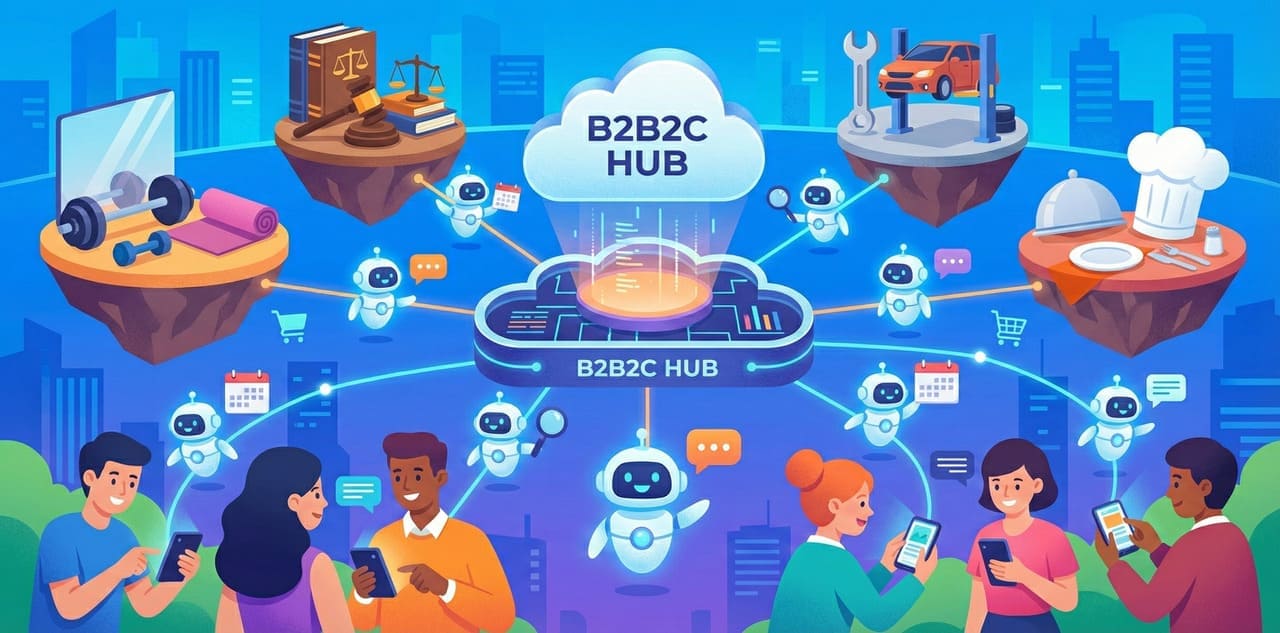
Imagine a world where you need to find a real estate attorney, schedule a car inspection, book a table at a popular restaurant, and order electronic components for a new project - all through one platform, within seconds, through a simple conversation with an AI agent. This world is not a futuristic fantasy; it's the reality that smart artificial intelligence agents are building right now, and it's called the marketplace revolution in the B2B2C model (business to business to consumer).
In the past, digital marketplaces were mainly sophisticated bulletin boards. They connected buyers with sellers, but the communication process, expectation alignment, and the transaction itself were still cumbersome and required significant human intervention. Today, we're witnessing a paradigm shift. Instead of being just passive intermediaries, marketplaces are becoming active ecosystems where virtual assistants and autonomous agents manage the interaction from end to end. This is a quantum leap driven by artificial intelligence that's changing the way businesses operate and communicate with their customers.
What Is the B2B2C Model and How Does AI Fit In? A Deep Dive
The B2B2C model is a business model where a company (B1) sells its products or services to another company (B2), which in turn sells them to the end customer (C). A classic example is a car manufacturer (B1) selling cars to a dealership (B2), and the dealership selling them to private customers (C).
The innovation is that the internet and AI allow B1, the marketplace platform, to create direct and interactive contact with C, even if the transaction goes through B2, the small business. This is where the modern marketplace comes in. It's not just a platform for B2 to display its wares, but a space where the AI agents of all participants - the customer, the small business, and the platform itself - communicate with each other autonomously.
The big challenge has always been coordination. How can a customer get reliable and immediate information from dozens of different businesses? How can a small business manage hundreds of inquiries simultaneously? The answer lies in standardization and automation - topics we explored in depth in articles about the economy of AI agents and Google's AP2 protocol, which creates a unified infrastructure for autonomous transactions. AI agents become the "digital employees" of every small business on the platform, allowing it to compete as an equal.
Not Just a Chatbot: The Fundamental Difference Between a Bot and an AI Agent
It's important to understand the technological leap. A traditional chatbot is usually a rule-based or script-based system. It can answer frequently asked questions, but it's limited to the knowledge base fed into it in advance. It doesn't truly "understand" context, and certainly can't perform complex actions.
An artificial intelligence agent, on the other hand, is much more than that. It is:
- Autonomous: It can make decisions and initiate actions on its own to achieve a goal.
- Connected to systems: It interfaces with external systems (like calendars, inventory databases, CRM systems) to retrieve information and perform actions.
- Learning and evolving: It uses machine learning to improve from every interaction.
- Managing multi-step conversations: It remembers the context of the conversation and can manage complex processes requiring multiple steps.
Want to consult with us?
We can help you choose, build and deploy the perfect AI solution for your business. Leave your details and we'll get back to you.
In simple terms, a chatbot answers questions; a smart AI agent solves problems and performs tasks.
The Role of AI Agents in the New Marketplace: A Technical View
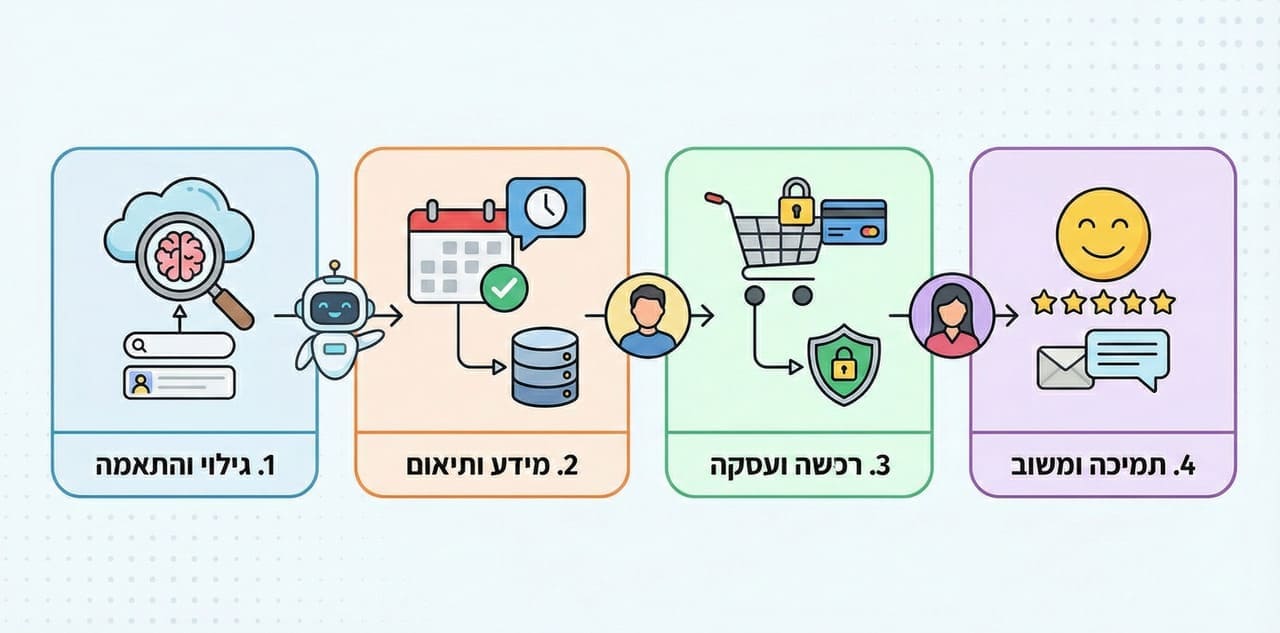
Smart bots and AI agents fulfill several critical roles that make the experience efficient and fast. Let's dive deep into each:
1. Discovery and Matching Agent: The Smart Search Engine
This is the first and most critical stage. Instead of simple keyword-based search, the discovery agent uses natural language understanding (NLU) technology to decode the user's true intent. When a customer writes "I'm looking for a real estate accountant in Tel Aviv who specializes in startups and has recommendations," the agent breaks down the request:
- Service: Accountant
- Location: Tel Aviv
- Specialization: Startups
- Social proof: Recommendations The agent doesn't just filter results - it ranks them by relevance, real-time availability (by querying the information agents of other businesses), and user ratings. It solves the "choice overload" problem and presents the customer with a short, precise list.
2. Information and Scheduling Agent: The Operational Heartbeat
After candidates are found, the questioning and coordination phase begins. This agent is essentially a 24/7 AI consultant. It connects directly to the business's information systems (CRM, ERP, calendars) via APIs and can provide accurate answers to questions like:
- "What's the cost to open a file?" (connects to the service price list)
- "Do you work with system X?" (connects to the company's knowledge base)
- "What's the nearest available appointment?" (connects to the calendar and finds an open slot) It can conduct basic negotiations, offer alternatives, and schedule meetings or appointments completely autonomously. This is a direct application of the ideas we discussed in the article about how to provide 24/7 customer service.
3. Transaction Agent: The Automated Checkout
For standard products or services, this AI agent turns desire into action. It manages the entire purchase process:
- Inventory and availability check: Verifies the product exists or the service is available.
- Final price quote: Including taxes, shipping, and any relevant additions.
- Details collection: Shipping address, invoice details, etc.
- Secure payment processing: Interfaces with payment gateways and ensures the transaction is completed securely, using protocols like AP2. It essentially does the work of a sales agent, but at a scale and speed no human can match.
4. Support and Feedback Agent: Maintaining the Relationship
The transaction doesn't end at delivery. This agent is responsible for the post-purchase customer experience. It uses sentiment analysis to understand customer satisfaction from communication. It can send proactive messages ("Your order is on the way!"), automatically request feedback and ratings, and handle common issues through a knowledge base. The collected feedback not only helps the business improve but also feeds the platform's discovery agent, creating a continuous improvement loop.
From Theory to Reality: A Detailed Use Case
To illustrate the power, let's follow the journey of a customer named Sarah, who wants to find a personal fitness trainer through a services marketplace:
- The Need: Sarah enters the app and writes: "I want to find a female fitness trainer for Pilates equipment training in the Ramat Gan area, twice a week in the evening. It's important to me that she has experience working with post-partum clients."
- Discovery and Matching: The discovery agent analyzes the request. Within seconds, it scans hundreds of profiles, checks trainer availability in real time, and presents Sarah with three trainers who exactly match all criteria, with high ratings and links to demo videos.
- Information and Scheduling: Sarah opens a chat with the information agents of two trainers simultaneously. She asks one: "What's the cost of a 10-session package?", and the other: "Do you have convenient parking?" The smart bots answer her immediately. She decides to schedule a trial session. The AI agent shows her the trainer's available times, and Sarah books a session directly from the chat.
- Purchase and Transaction: After a successful trial session, Sarah wants to purchase a package. The purchase agent sends her a secure payment link. She pays, and the sessions automatically sync with her personal calendar and the trainer's calendar.
- Support and Feedback: The day after each session, the support agent sends Sarah a message: "Hi Sarah, how was yesterday's session?" After a month, it asks her to rate the experience. Her positive feedback improves the trainer's ranking on the platform.
This entire process, which in traditional methods would take days of phone calls, messages, and waiting, was completed in minutes, smoothly and efficiently.
Benefits for All Parties in the System
The transition to an AI-based marketplace is not just a technological upgrade; it creates economic value for all participants.
-
For the Customer (C):
- Time savings: Getting answers and completing tasks in minutes instead of hours or days.
- Transparency and comparison: Easy access to reliable information enabling better decision-making.
- Availability: 24/7 service regardless of business operating hours.
-
For the Business (B2):
- Operational efficiency: Automation of repetitive tasks like answering questions, scheduling appointments, and accepting orders.
- Revenue growth: Immediate handling of leads and the ability to serve more customers in less time.
- Competitiveness: Small businesses can offer the service level of large corporations, as we expanded on in the article about replacing employees with AI agents.
- Data-driven insights: Every interaction of the chatbot or agent is recorded and analyzed, providing the business with valuable insights about customer needs.
-
For the Platform (B1):
- Strong business model: Collecting commissions on actual transactions, not just exposure.
- Data collection: Deep understanding of market needs, enabling continuous platform improvement and new service offerings.
- Stickiness: The more efficient the platform, the less likely businesses and customers are to leave it.
Challenges and Opportunities for the Future: A Sober Look
Of course, the transition is not without challenges. There are issues of data security at the highest level, ensuring ethics and fairness of algorithms to prevent discrimination, and the critical need for human oversight (Human in the loop) for handling complex or sensitive cases that AI cannot solve.
However, the opportunity here is far greater than the risks. We're expected to see hyper-personalized marketplaces that know us better than we know ourselves, predictive analytics that will help small businesses manage inventory and demand, and the emergence of entirely new services that weren't possible before.
We at WhaleBiz believe the future belongs to platforms that will build open ecosystems based on smart AI agents. We specialize in building custom AI solutions that allow businesses to turn their information and processes into autonomous digital assets. Whether you're a large marketplace aspiring to become a smart platform, or a small business wanting to join the revolution - we have the tools and expertise to help you.
The revolution has already begun. Businesses that don't adopt digital workforce and the smart marketplace model will find themselves left behind. Contact us today to explore how artificial intelligence agents can propel your business forward.
Frequently Asked Questions
What is the B2B2C model and how do AI agents fit into it?
The B2B2C model is a business model in which one company (B1) sells products or services to another company (B2), which in turn sells them to the end customer (C) - for example, a car manufacturer that sells to a dealership that sells to a private customer. AI agents let the marketplace platform create direct, interactive contact with the end customer, even when the transaction goes through the small business. In the modern marketplace, the AI agents of all participants - the customer, the small business, and the platform - communicate with each other autonomously.
What is the difference between a traditional chatbot and a smart AI agent?
A traditional chatbot is usually a rule-based or script-based system, limited to the knowledge base fed into it in advance, and it does not truly understand context. An AI agent, by contrast, is autonomous, connected to external systems such as calendars and CRM systems, learns and improves from every interaction, and manages multi-step conversations while remembering the context. In simple terms, a chatbot answers questions, while a smart AI agent solves problems and performs tasks.
What roles do AI agents play across the customer journey in a marketplace?
The article describes four key roles: a discovery and matching agent that decodes the user's intent using natural language understanding and ranks relevant results, and an information and scheduling agent that connects to the business's systems and provides answers and books appointments 24/7. In addition, there is a transaction agent that manages the entire purchase process, including inventory checks, price quotes, and secure payment processing, and a support and feedback agent that accompanies the customer after the purchase and collects feedback. Together they create a seamless end-to-end experience and a continuous improvement loop.
How does a small business benefit from an AI-based marketplace?
For the small business, an AI-based marketplace brings operational efficiency by automating repetitive tasks such as answering questions, scheduling appointments, and accepting orders. It enables revenue growth through immediate handling of leads and serving more customers in less time, and it lets small businesses offer the service level of large corporations. In addition, every interaction by the agent is recorded and analyzed, providing the business with valuable insights about customer needs.

Michael Romm
Michael is the founder and CEO of WhaleBiz, leading business and marketing strategy. An expert in data (SQL, Python) and developing automation and AI solutions for businesses.