
AI for Business 2026: Implementing Smart Assistants That Actually Work

AI for Business: Implementing Smart Assistants in 2026
September 2026 update: this article was written at the end of 2025 looking ahead to 2026. Since then every model line such a solution rests on has been replaced: the Claude 5 family at Anthropic, the GPT-5.6 family and GPT-6 Astra at OpenAI, and Gemini 3.8 Flash alongside Gemini 3.1 Pro at Google. Hebrew support is considerably better today than it was at the time of writing. The principles in the body of the article - the difference between a menu bot and an assistant, preventing hallucinations, and the need for CRM integration - have not changed. The current line-ups and prices are in our AI model comparison.
The Bottom Line: Why Your Business Needs This Now
We are standing at the threshold of 2026. If a year or two ago integrating AI was a "nice bonus" or a marketing gimmick, today artificial intelligence for business is critical operational infrastructure - exactly like a CRM system or a website. The real revolution is not in simple "if-then" automation, but in the shift to assistants based on Large Language Models (LLMs) and Data Science. These new tools don't just "answer customers" - they understand context, identify purchase intent, analyze sentiment, and perform complex actions in real time. Businesses that implement smart assistants see a dramatic drop in load on human support teams and a significant rise in conversion rates, all while improving the end-to-end customer experience - provided they follow a practical 5-step guide to implementing AI the right way.
The Core Problem: Why Your Chatbot Doesn't Sell
Let's talk about the current reality. Most of us know the frustration: you land on a company's website, a chat bubble pops up, and after two questions you find yourself in an endless loop of "I didn't understand your question" or a limited button menu that doesn't address your actual need. The result? The customer abandons the conversation - or calls in frustration.
The reason for this failure is a deep professional gap. Most solutions on the market are implemented by digital agencies or marketing companies. They excel at campaigns, but lack deep technological understanding of data. They use ready-made templates and apply off-the-shelf solutions.
This is where WhaleBiz enters the picture. We are not a digital agency. We are a team of Data Science experts. We identified that the market is flooded with superficial solutions, while businesses need an analytical mind. Our ability to build models, analyze data, and deeply understand the architecture of language models enables us to create assistants that don't just "recite" text - they think.
The New Generation: The Difference Between Old Bots and AI Assistants
To understand the technological leap, it's important to distinguish between two types of systems:
- Rule-Based Systems: These are the old bots. They operate on a rigid decision tree defined in advance. If a customer asks a question in a phrasing that wasn't anticipated - the system fails.
- Autonomous Generative AI Agents: The systems we build. They are based on natural language understanding. The assistant can hold a flowing conversation, remember what was said at the beginning of the exchange, and draw conclusions.
Comparison Table: What Does the Business Get?
| Feature | Traditional Chatbot (Digital Agency) | Smart Assistant (WhaleBiz) ✓ |
|---|---|---|
| Technology | Decision trees and keywords | Language Models (LLM) and RAG |
| Flexibility | Gets stuck when no answer is defined | Generates dynamic, accurate responses |
| Context Understanding | Zero (each question stands alone) | Remembers the entire conversation history |
| Purpose | Initial filtering only | Full problem resolution and deal closure |
| Customer Experience | Robotic and frustrating | Human, empathetic, and personal |
Business Applications: Beyond Theory
Properly implemented AI for business touches every touchpoint of the organization. Here are real examples of what we do day to day:
1. The Salesperson Who Never Sleeps
Imagine a sales rep who knows every technical specification of your products, remembers all current promotions, responds to a lead that comes in at 2:00 AM within seconds, and knows how to handle sales objections elegantly. Our assistants can take a cold lead, warm them up through natural conversation, and schedule a meeting in the human salesperson's calendar only when the customer is ready.
2. Customer Service at Manager Level
Instead of answering "where is your branch?" for the thousandth time, the smart assistant integrates with enterprise systems. It can check order status, generate invoices, change delivery dates, and resolve complex technical issues based on the company's operational manual.
3. Internal Knowledge Management
Not just for end customers. Organizations accumulate enormous amounts of data. An internal assistant lets employees ask "What is the procedure for returning a defective product of type X?" and get an immediate answer based on the company's PDF documents and procedures, instead of digging through folders.
Want to consult with us?
We can help you choose, build and deploy the perfect AI solution for your business. Leave your details and we'll get back to you.
Is It Safe? Reliability and Preventing "Hallucinations"
One of the most important questions managers ask is the fear of "hallucinations" - situations where the AI invents information. This is a completely justified concern when working with generic tools like the open version of ChatGPT.
At WhaleBiz, we solve this with RAG (Retrieval-Augmented Generation) architecture. In simple terms: we create a "fence" around the business's information. The assistant does not draw information from the general internet, but only from the controlled knowledge base we've fed it (your website, procedure files, chat history). We define strict guidelines: "If you don't know the answer based on existing information, don't invent - transfer to a human agent."
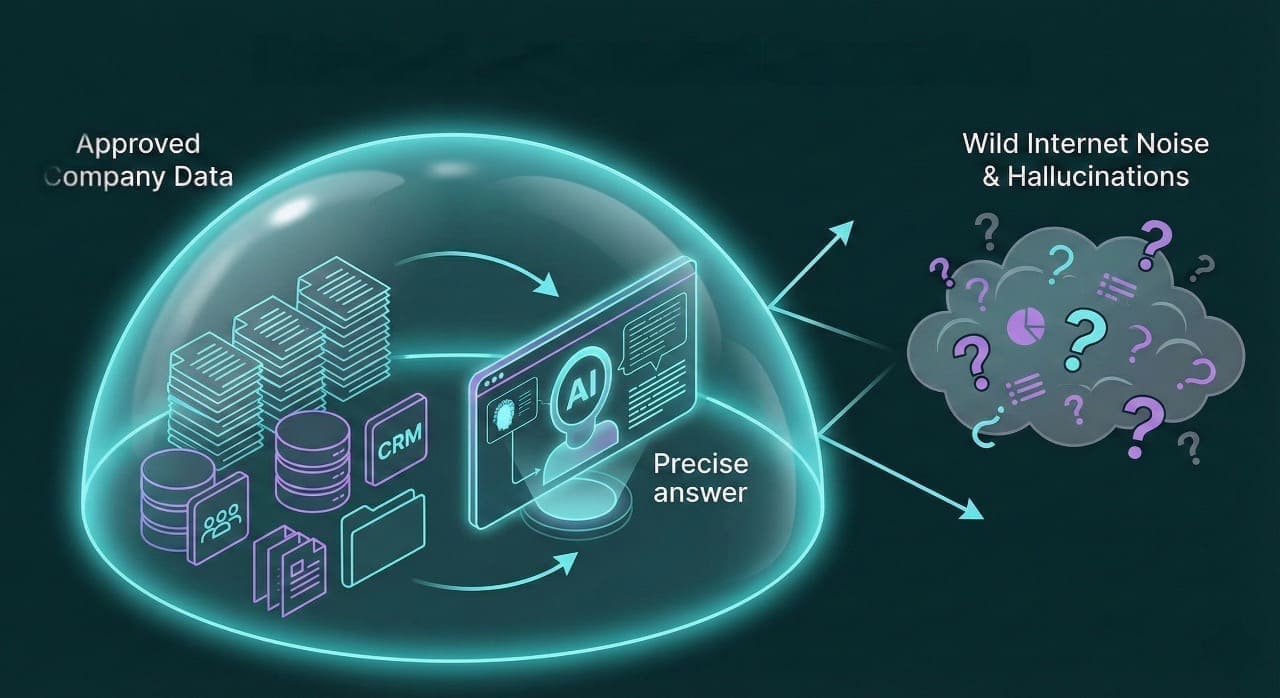
This is how we guarantee 99.9% accuracy and protect the brand's reputation.
Key Considerations for 2026
- Customer expectations have shifted: Zero-latency response is now the standard. A customer who doesn't get an immediate answer moves to a competitor.
- Personalization is king: An assistant that addresses the customer by name and references their purchase history sells far more than a generic bot.
- Human-machine collaboration: The goal is not to replace employees, but to free them from repetitive tasks (like password resets or basic FAQ questions) so they can focus on complex problem-solving and high-touch interactions.
FAQ: AI for Business
Q: Does the system support multiple languages well?
Absolutely. The models of 2025-2026 have come a long way. At WhaleBiz we perform specific fine-tuning for each language, including slang, common spelling variations, and cultural nuances relevant to your market.
Q: How long does it take to launch such a project?
Unlike software projects that took months in the past, thanks to our Data Science expertise and the infrastructure we've built, we can deliver a working MVP within a few weeks.
Q: Is this only suitable for large enterprises?
No. The technology has become accessible. Any business receiving dozens of inquiries per day or managing complex sales processes can achieve ROI quickly through labor savings and improved conversion rates.
Q: How does it integrate with my existing systems?
Our assistants communicate with CRM systems, calendars, and inventory management via API. They function as an integral part of your business ecosystem, not in isolation.
Why WhaleBiz?
The market is flooded with promises. Our uniqueness is in our DNA. We are not creative people who tried to learn AI. We are data people who learned business.
Our approach is scientific:
- Analysis: We dive into the logs of your past conversations to understand where the failures are.
- Building: We tailor the precise model to your needs (not "one size fits all").
- Optimization: We don't "launch and forget." We monitor conversations, see where the assistant struggled, and continuously improve it.
2026 brings new standards. Your customers are already there, expecting a smart, fast, and accurate experience. Don't stay behind with a chatbot that only knows how to collect a name and phone number.
Ready to Take Your Business to the Next Level with Real AI?
Let's assess together whether your business is ready for the revolution. We invite you to a short, focused discovery call where we'll show you how our assistants can integrate into your operations.
Contact us or leave your details in the form, and our experts will get back to you with insights, not slogans.

Michael Romm
Michael is the founder and CEO of WhaleBiz, leading business and marketing strategy. An expert in data (SQL, Python) and developing automation and AI solutions for businesses.