
The End of Dumb Bots: Transitioning to Smart AI Agents

"Hello, I'm the bot of X. Press 1 for hours, press 2 for address..."
If you've ever called customer service and heard that phrase, you know exactly what we're talking about. Script-based bots - or as the industry calls them, "dumb bots" - have dominated the Israeli market for years. They're cheap to set up, simple to operate, and... incredibly frustrating for customers.
We all know the feeling: you know exactly what you need, but the bot doesn't understand you. You press buttons, repeat yourself, and eventually shout "Agent! Human!" hoping someone real will answer.
But reality is changing, and changing fast. Data from the Israeli Central Bureau of Statistics shows that 28% of Israeli businesses now use artificial intelligence - more than double the European average of 13%. And what's even more interesting: the vast majority are switching from script bots to advanced AI agents.
In this article, we'll examine why this is happening, what the real difference is between the technologies, and how Israeli businesses can join the revolution that has already begun.
"Dumb Bot" vs. "Smart AI Agent": The Difference That Changes Everything
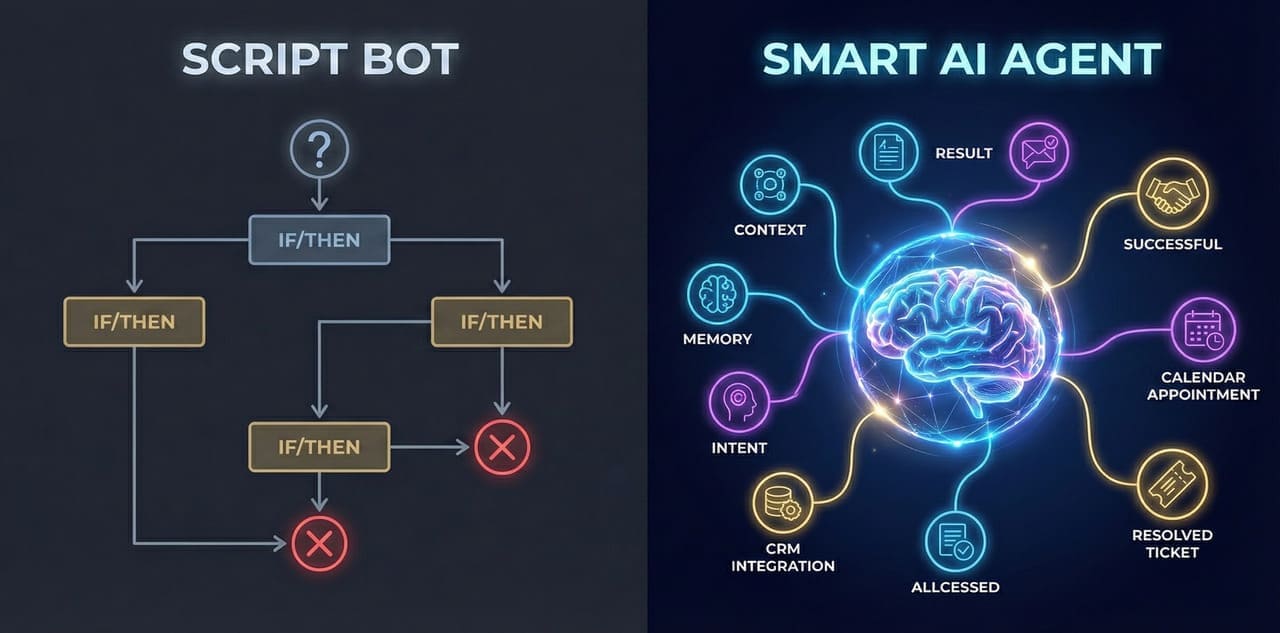
The Traditional Bot: A Fixed Decision Tree
Traditional bots operate on the basis of a decision tree or simple RAG (Retrieval Augmented Generation). In simple terms:
- They have a pre-made, limited and fixed set of answers
- They "pull" answers based on single keywords
- They have no real understanding of context or intent
What does this look like in practice? The customer writes: "I want to cancel my subscription." The bot searches for the keyword "cancel" and returns: "To cancel a subscription, call 03-XXXXXXX." End of conversation. No empathy, no attempt to understand why, no offer of an alternative.
The Smart AI Agent: Understanding, Learning, Acting
A smart AI agent is fundamentally different - not just in the technology, but in the entire approach:
Understanding context: The agent understands what the customer means, not just what words they used. "I'm fed up with this product" translates to a complaint requiring immediate attention, not a search for the keyword "fed up."
Continuous learning: Every conversation improves the agent. It identifies patterns, learns what works and what doesn't, and refines its responses accordingly.
Autonomous action: Unlike a bot that only returns information, a smart agent can actually do things - check stock availability, schedule a meeting, update a CRM record, send a confirmation email.
Asking clarifying questions: When the request is unclear, the agent asks smart questions to understand context - like a good human employee would.
Why is Israel Moving to AI Agents Faster Than the Rest of the World?
Israel has some unique advantages that accelerate this transition:
1. Strong Technological Ecosystem
25% of Israel's high-tech startups work in AI, and 47% of investments in the sector are directed to the field. Israel is a global AI powerhouse, and businesses here have access to experts, technologies, and knowledge unavailable elsewhere.
The meaning: we have access to the most advanced technology, and professionals who know how to implement it. The gap between what can be done and what businesses are actually doing - that's the business opportunity.
2. Demanding Israeli Customers
The average Israeli has no tolerance for bad service. Customer expectations here are especially high, and dumb bots that frustrate - simply drive customers to competitors.
Research from the Chamber of Commerce showed that 68% of Israeli customers will abandon a brand after a single bad service experience. Businesses that want to stay competitive understand they need to upgrade - fast.
3. Active Government Support
The National Artificial Intelligence Program encourages AI adoption across all sectors of the economy. There are grants, tax benefits, and training - making the transition cheaper and more accessible even for small businesses.
4. High Adoption in High-Tech That Affects Everyone
95% of Israeli high-tech workers use AI tools on a regular basis. This habit "trickles down" to the rest of the economy - people accustomed to working with AI at work expect to receive AI-based service as customers too.
Want to consult with us?
We can help you choose, build and deploy the perfect AI solution for your business. Leave your details and we'll get back to you.
Real Examples from the Field
Large Insurance Company
Before: A script bot that referred 70% of inquiries to human agents. Customers complained about long wait times and impersonal service.
After: An AI support agent that handles 85% of inquiries autonomously, including filing simple claims, tracking existing claim statuses, and coordinating with agents.
Result: 40% savings in call center costs, 25% increase in customer satisfaction.
Retail Chain
Before: A "smart" chat on the website that only answered frequently asked questions from a limited list. Most customers ignored it.
After: An AI sales agent that understands what the customer is looking for, recommends relevant products, answers questions about specifications and availability, and completes orders.
Result: 25% increase in website conversions, 30% reduction in cart abandonment.
Law Firm
Before: A "Contact Us" form that was answered within 24-48 hours. Many leads cooled off or turned to competitors.
After: An AI initial consultation agent that answers immediately, identifies the type of inquiry, collects relevant initial details, and schedules a meeting directly in the available attorneys' calendars.
Result: Doubled the number of quality inquiries, reduced response time from 24 hours to seconds.
The Challenges in Transitioning - and How to Handle Them
Transitioning from a dumb bot to an AI agent is not trivial. Here are the common challenges and how to deal with them:
1. Higher Initial Cost
An AI agent requires a higher initial investment than a script bot - more development, more integrations, more training.
But: ROI is usually achieved within 3-6 months. As we explained in the article on measuring AI ROI, savings in personnel and revenue improvements cover the investment quickly. The common mistake is looking at the initial cost without calculating the long-term operating cost.
2. Integration with Existing Systems
An AI agent needs to connect to your CRM, ERP, and calendar systems to perform real actions. This requires custom integration development tailored to the existing architecture.
The solution: Work with a team that understands both AI and integrations. Not every AI company knows how to connect systems, and not every development company understands AI.
3. Oversight and Control
Even though an AI agent learns and improves, it still needs supervision. Clear "rules of engagement" must be defined:
- When to transfer to a human agent?
- What decisions not to make autonomously?
- How to handle unusual situations?
4. Team Training
Employees need to understand how to work alongside the agent, not against it. This requires a cultural shift, not just a technical one.
How to Start? 5 Practical Steps
Step 1: Process Mapping
Identify which tasks recur in your service center or sales department. Start with the simplest and most frequent tasks - that's where ROI is highest.
Step 2: Define Measurable Goals
Is the objective cost savings? Improved customer experience? Increased sales? Defining clear KPIs will help you measure success.
Step 3: Choosing a Suitable Provider
Not every AI solution is right for every business. Professional consulting will save you costly mistakes. Look for a provider who understands your industry and can show similar successes.
Step 4: Focused Pilot
Start with one specific process, measure results over 2-3 months, and expand gradually only after you've proven success.
Step 5: Continuous Optimization
An AI agent improves over time, but it needs to be fed with feedback and data. Set up a regular review process and improve consistently.
Summary: The Revolution is Already Here - The Question is When You'll Join
Dumb bots are going to disappear. Not tomorrow, but certainly within a few years. Businesses that continue to cling to old technology will find they're losing customers to competitors who have already adopted smart AI agents.
The good news? The transition is easier than you think. With the right guidance, a tailored solution, and professional training - every business can transform its customer service from a frustrating experience to an exceptional one.
Your customers are already expecting it. Your competitors are already working on it. The question is - when do you start?
Ready to upgrade? Talk to us and we'll show you exactly how it works in practice.
Frequently Asked Questions
What is the fundamental difference between a script-based bot and a smart AI agent?
A script-based bot runs on a fixed decision tree or simple RAG, pulling pre-written answers based on single keywords, and any deviation from the script causes it to break or hand off to a human agent. An AI agent is built on large language models like GPT, Gemini, or Claude, and understands natural language, context, and intent. In short: a chatbot answers questions, while an AI agent solves problems.
How long does it take to recoup the investment in switching to an AI agent?
An AI agent does require a higher upfront investment than a script-based bot, but ROI is usually achieved within 3-6 months. The savings in personnel and the improvement in revenue cover the investment quickly. The common mistake is looking only at the initial cost without calculating the operating cost over time.
What can an AI agent do beyond answering questions?
Unlike a script-based bot that performs no tasks, an AI agent connects to your business systems such as CRM, calendars, inventory, and payment systems, and acts on its own. It can schedule meetings, place orders, update the CRM, and manage complex processes without human intervention. This is the capability that lets it close deals and not just provide information.
Where should a business start the transition to an AI agent?
It is best to start with process mapping and identify the simplest and most frequent recurring tasks in your service center or sales department, because that is where ROI is highest. Next, define measurable goals and clear KPIs, choose a suitable provider, and run a focused pilot on a single process for 2-3 months. Only after you have proven success should you expand gradually.

Michael Romm
Michael is the founder and CEO of WhaleBiz, leading business and marketing strategy. An expert in data (SQL, Python) and developing automation and AI solutions for businesses.