
Lead Generation Bot: The Smart Way to Double Your Inquiries | WhaleBiz

Lead Generation Bot: The Active Engine That Turns Traffic into Deals
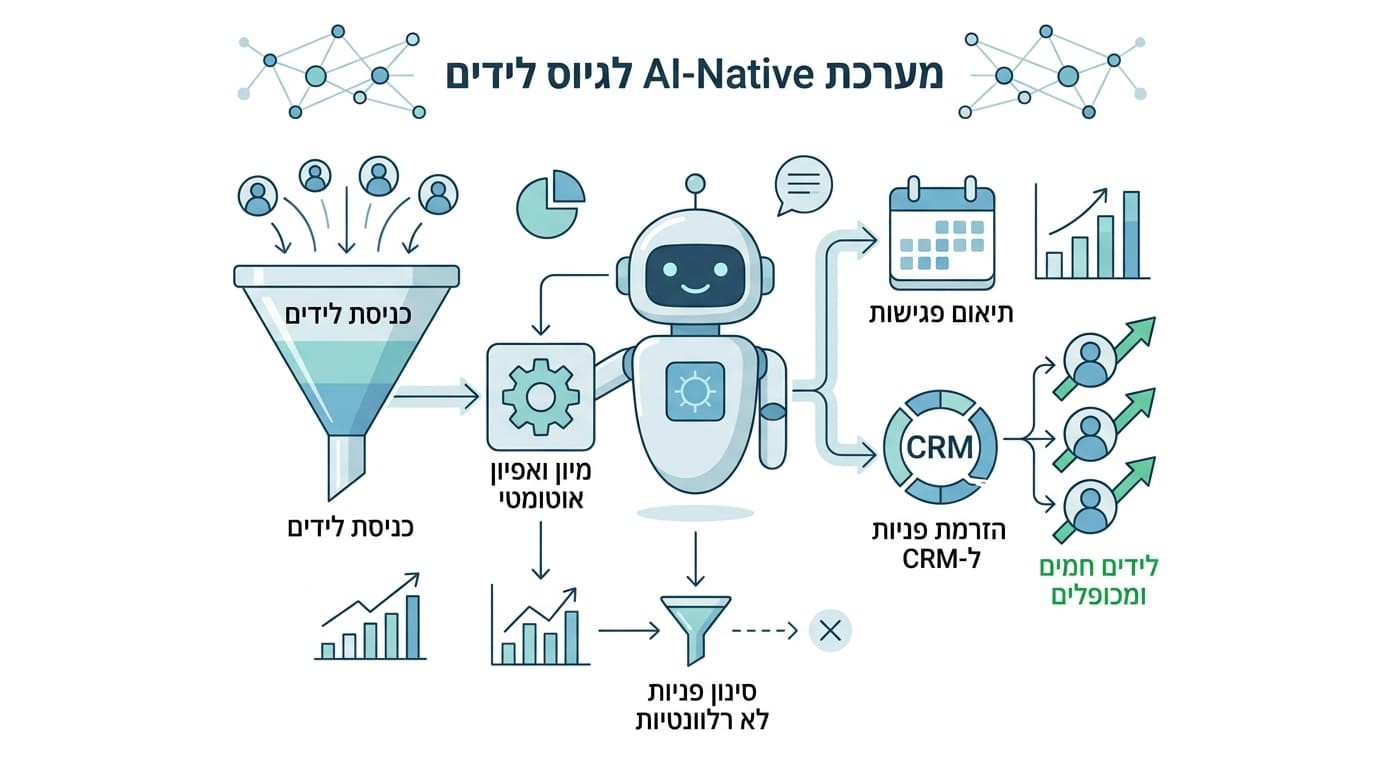
In a nutshell, for those who want the bottom line as quickly as possible: smart digital systems designed to capture, filter, and qualify inquiries from prospective customers have become the new standard of digital marketing. Instead of relying on static, tedious "contact us" forms where the customer fills in their details and waits days for a reply, modern technology creates proactive interaction. The system identifies the visitor, opens a natural conversation, asks the right questions to understand their needs, logs all the information instantly, and passes only quality-filtered, commercially ready inquiries on to the human team. This way, organizations stop wasting expensive advertising budgets on abandoning visitors and maximize their conversion rates.
Now that we have summarized the essence, it's time to dive deeper. In today's competitive business world, the consumer's attention is the most precious and scarce resource of all. Companies spend enormous sums on advertising platforms, search engine optimization, and social media campaigns just to bring the prospective customer to their digital doorstep. But what happens at that critical moment when the visitor lands on the website or landing page? The following article breaks down the biggest challenge facing marketing and sales departments and presents a deep, comprehensive technological solution that changes the rules of the game from the ground up.
The Traffic Paradox: Plenty of Clicks, Few Conversions
The digital marketing industry has conditioned business owners to focus on metrics such as impressions, clicks, and cost per click. Yet the most painful figure, the one many tend to ignore, is the conversion rate. The statistics show that the vast majority of visitors - often more than 95% - abandon the website without leaving any trace.
The reason for this is not necessarily a lack of interest in the product or service, but rather the fact that the average digital experience demands effort from the customer. A contact form with five separate fields is perceived as a burdensome chore. The customer fears their details will be passed on to mailing lists, they don't know when someone will get back to them, and very often they simply need a quick answer to one simple question before they are ready to hand over their phone number.
A note on the side: the gap between the instant consumption experience (such as ordering food on an app or watching content at the press of a button) and the experience of waiting on a business creates frustration. The customer of 2026 expects personal, immediate, and focused attention at any hour of the day.
This realization led to a search for communication solutions that would bridge the gap. Integrating an AI chatbot into your business is already an excellent and important step that guarantees advanced technological responses for customers. That said, at WhaleBiz we take that excellent foundation one step further, toward full proactivity. The system does not wait passively but identifies the visitor, opens a human conversation, and knows how to steer the dialogue with the goal of extracting the business information needed for the next stages.
The Shift from Passive Communication to Active Communication
The term "conversational marketing" describes the shift from one-way forms to a live dialogue. When a person walks into a physical store, a good salesperson approaches them, greets them, and asks how they can help. The salesperson doesn't shove a form at them to fill in their details, send them home, and promise to call tomorrow. They hold a conversation aimed at understanding the precise need.
In the digital space, deploying a quality lead generation chatbot ensures that every shekel invested in an advertising campaign receives the treatment it deserves. The system replaces the physical salesperson. It analyzes which page the visitor is on, where they came from, and knows how to tailor the opening line to the specific context.
The Operational Breakdown: How Does the Process Actually Work?
The process by which anonymous traffic becomes concrete business information is made up of several well-defined stages, each of which is managed autonomously by the system.
Identifying and Initiating the Conversation
Instead of waiting for the visitor to look for the contact button, the system recognizes behavioral patterns. If a visitor lingers on a pricing page for more than 30 seconds, the system will initiate a relevant outreach: "Hi, I noticed you're looking at our packages. Would you like me to help you figure out which one fits the size of your business exactly?" This outreach breaks the ice and invites a natural dialogue.
Professional Filtering and Profiling
Not every inquiry is a worthwhile business opportunity. Sales departments waste long hours every month on calls with people who don't have the required budget, don't understand what the service is about, or are looking for something the company doesn't even offer.
The smart system performs this entire grunt-work filtering process on its own. During the natural conversation, it elegantly weaves in key questions. In the B2B world, it's common to use the BANT model (Budget, Authority, Need, Timeline). The system will find out the customer's timeline for the project, the ballpark of the budget they are allocating, and their most pressing need. All of this without making the customer feel like they are being cross-examined, but rather as part of a natural flow of consultation. Beyond dry data collection, the technology can function just like an AI sales agent that knows how to handle basic objections, explain your competitive advantages, and reinforce your brand value during the conversation.
Seamless Handoff to a Human
The moment the system identifies that the inquirer meets the desired criteria and represents a quality opportunity, it can offer to schedule a phone or Zoom meeting directly into the human team's calendar. Alternatively, it can trigger a real-time alert to an available representative who takes over the conversation right then and there, with the entire chat history displayed in front of them. The customer never has to repeat themselves.
The WhaleBiz Revolution: From Point Tools to a Living Infrastructure
When you analyze the Israeli and global markets, it's easy to spot a painful anomaly. Many companies rush to purchase various technological add-ons and embed them on their websites. The problem is that these tools often operate in a vacuum (Silo). They hold a great conversation, but the information stays trapped inside an external application and never syncs with the core of the business.
After meticulously analyzing the field and processing more than half a million messages from various clients, our team, which comes from the world of Data Science, realized that the root of the problem is not in the language capabilities but in the infrastructure. The traditional CRM (customer relationship management) systems on the market were developed many years ago, under one founding assumption: the user is a flesh-and-blood human who types in data, updates fields, and clicks save buttons.
When you try to connect an advanced digital worker to a system designed for a slow human, the old system collapses or simply fails to realize the potential. It has no cross-conversation memory, it struggles to capture insights from conversation sentiment, and the processes break down.
Creating the First AI-Native CRM
That is why we chose not to be just another company selling a "feature" or a widget for your website. At WhaleBiz, we developed a complete work environment - an AI-Native CRM. This is a system in which the digital workers are "first-class citizens." The system was designed from the ground up specifically to let them do their work seamlessly. They open new customer records, summarize conversations into key points, change handling statuses, and create an organized dataset from which the human team only needs to harvest the fruit. We build the system on which the intelligence runs, not just supply the intelligence itself.
Want to consult with us?
We can help you choose, build and deploy the perfect AI solution for your business. Leave your details and we'll get back to you.
Open Integrations and Uncompromising Data Security
In a reality where businesses have already invested tens and hundreds of thousands of shekels in ERP systems, accounting software, and complex enterprise software solutions (such as Priority, Salesforce, Monday, and others), the assumption that a company will drop everything and switch to a completely new system overnight is unrealistic.
With this understanding in mind, our platform's architecture was built with a fully open API approach. Our infrastructure serves as the core engine for managing the digital workers, but it is capable of "talking" to any enterprise system you already work with. Information flows freely and bidirectionally, so there is no need to type things in twice or worry about losing data in the transition between software programs.
Another critical point is the question of security. As an official Meta Tech Provider and a participant in the AWS for Startups program, we are committed to meeting the strictest international standards of privacy, resilience, and stability. Our solutions rely exclusively on secure, official connections. We don't deal in shortcuts or "hacks" that could jeopardize the integrity of your business data or expose you to blocks from the various communication platforms.
The Fear of Mistakes: How Do You Ensure the Information Is Accurate?
Many managers consider integrating advanced tools into their business but stop at the last moment because of a familiar concern: what happens if the system answers incorrectly? Companies worry about a scenario in which automated technology gives a customer wrong pricing information, invents a returns policy that doesn't exist, or commits to a delivery that can't be met. In the industry, this phenomenon is known as reliance on unsubstantiated completions from open models.
Our approach solves this problem completely through a closed, data-driven architecture. Our AI agents do not draw knowledge from across the entire internet when they converse with your customers. They are exclusively grounded in your business's secure database. You are the ones who feed in the product catalog, the policy manuals, the answers to frequently asked questions, and the pricing limits.
If the customer raises an issue that does not appear in the organizational documents, the system is programmed not to guess. Instead of risking mistakes that could cause reputational or legal harm to the business, the digital agent will politely apologize and note that the question requires more in-depth review, and will pass the inquiry on to a qualified human. This methodology gives company managers the peace of mind they need to run an automated, reliable business.
The Return on Investment (ROI) Model: The Economics Behind the Technology
To justify a significant operational change, a business needs to see a clear profit line. The economics behind the move to smart, automated communication are clear and proven. Let's analyze the numbers through a few key variables:
- Savings on labor and recruitment costs: Sales teams spend around 30% to 40% of their time trying to reach leads who aren't available, or on qualifying calls with irrelevant prospects. The hourly cost of a skilled salesperson is high, and when they are tied up with the administration of filtering, the business loses out. The system replaces the "grunt-work" filtering stage and lets your salespeople focus solely on closing profitable deals.
- Preventing abandonment during off-hours: Customers look for solutions on weekends, holidays, and in the small hours of the night, too. A business that relies solely on human responses loses a huge share of the market. A system that operates 24/7 captures those opportunities in real time, books meetings for the next day, and makes sure the customer doesn't move on to a competitor.
- Customer acquisition cost (CAC): When you improve the conversion rate from your existing website traffic, you are in fact directly lowering the acquisition cost of every new customer. There's no need to double your Google advertising budget; it's enough to optimize how you handle the people who have already clicked on your ad.
Comparison Table: Methods of Generating Prospects
To put things in order, we have compiled a comparison of the different approaches commonly used in the market today:
| Evaluation criterion | Standard website contact form | Human team only (SDR) | WhaleBiz platform (AI-Native) |
|---|---|---|---|
| Response time and availability | No immediate response, depends on the team's handling time | Limited to business hours, creating wait times and bottlenecks | Response in a fraction of a second, continuous 24/7 operation with no breaks |
| User experience and convenience | Tedious, requires typing effort, no added value | Personal and flexible, but subject to moods and varying interaction quality | A natural, pleasant conversation, with real-time personalization of the message |
| Filtering and qualifying inquiry quality | Superficial, relies on pre-set mandatory fields | High-quality and thorough, but wastes valuable organizational time of professionals | Precise and automatic, based on dynamic questions and analysis of the answers |
| Logging and data entry | Forwarded to email, usually requires manual entry or Zapier connections | Requires human typing, prone to being forgotten, errors, and lost information | Instant saving in the dedicated CRM, including a conversation transcript and executive summary |
Something to think about: integrating technology does not replace your team, it empowers it. Salespeople who work with rigorously filtered leads are happier salespeople, with higher close rates, lower burnout, and sky-high motivation.
Professional FAQ for Business Owners
Adopting deep technologies naturally raises questions and concerns among managers who want to preserve their brand's character. We have gathered here the most comprehensive answers to the most important questions.
Do customers notice that they aren't talking to a real person?
Current technology is advancing at levels that are hard to describe. The language isn't robotic; it includes slang, emojis, and an understanding of nuance. In most cases, we recommend that our clients act with transparency and let the digital agent introduce itself as such (for example: "Hi, I'm the company's digital assistant, I'd be happy to point you to the right professional"). This transparency builds trust, and customers value the fast response far more than the identity of whoever is answering them.
Is a lead generation bot suitable for small businesses too, or only for huge corporations?
One of the great breakthroughs of modern language technologies is the democratization of the tools. What once required enormous budgets and in-house development teams is accessible today to any business. A smart platform can serve a solo lawyer who receives consultation inquiries and wants to schedule meetings in their calendar with the same level of skill it serves a large real estate company managing thousands of inquiries a month. The system scales according to your volume of activity.
How long does it take to set up an infrastructure like this and go live?
Thanks to the fact that our AI-Native CRM infrastructure is already up and running and ready, the setup time for an average project is significantly shorter than the industry tends to assume, usually standing at just a few weeks. Our process includes in-depth scoping together with you, gathering the organizational knowledge bases (frequently asked questions, catalogs, work procedures), comprehensive training of the model, carrying out integrations via the API to existing systems, and rigorous quality testing before launch.
How does the system handle customers who respond negatively or angrily?
The language agents are programmed to be extremely service-oriented and empathetic. They include real-time sentiment analysis capabilities. If the system detects that the customer is frustrated, using blunt language, or expressing impatience, it does not keep managing the conversation in the usual manner. It apologizes for the inconvenience, notes that it is escalating the inquiry for urgent attention by a senior manager, and triggers an immediate alert to the human team so they can take over.
Can the tone and style of the conversation be controlled?
Absolutely. During the setup and training process, we define the digital "persona." A youth fashion brand will use light, direct, and enthusiastic language. An investment house or a financial advisory firm, by contrast, will get an agent that phrases things in an authoritative, formal, respectful, and cautious manner. Your brand identity is carefully preserved.
Business reality presents us with new challenges every day, and organizations that ignore the need for operational evolution will find themselves in a fight for survival against nimbler, smarter competitors. Bringing quality traffic to your website and digital assets is a hard and expensive task. To let that traffic simply evaporate due to the absence of a fast, quality human response is a loss no business can afford.
We, the team of experts at WhaleBiz, have built a holistic, secure, and smart infrastructure that connects the most advanced data science with the simple, everyday needs of managing customers on the sales floor. Now is the time to move your organization into the next generation of enterprise communication, to stop chasing cold prospects, and to let technology work for you. We invite you to leave us your details, and an expert from our team will be happy to get back to you to demonstrate how real artificial intelligence can upgrade the processes in your business.

Eva
Eva is the Events and Community Manager at WhaleBiz, leading community engagement, webinars, and professional industry events. Combining a background in behavioral sciences with digital strategy and SMM, she creates high-impact experiences and drives brand presence across social platforms.