
The Death of the Contact Form: How to Stop Losing Customers

"Leave Your Details and We Will Get Back to You": The Sentence Killing Your Sales in 2026
It happens on your website thousands of times a day, and you don't even know it. A potential customer, with a credit card in hand and true purchase intent, enters your site. They are impressed by the service, read the recommendations, and decide they want to move forward. They click on "Contact Us".
And then they see it: three gray fields, a boring "Submit" button, and a vague promise that "someone" will get back to them "as soon as possible".
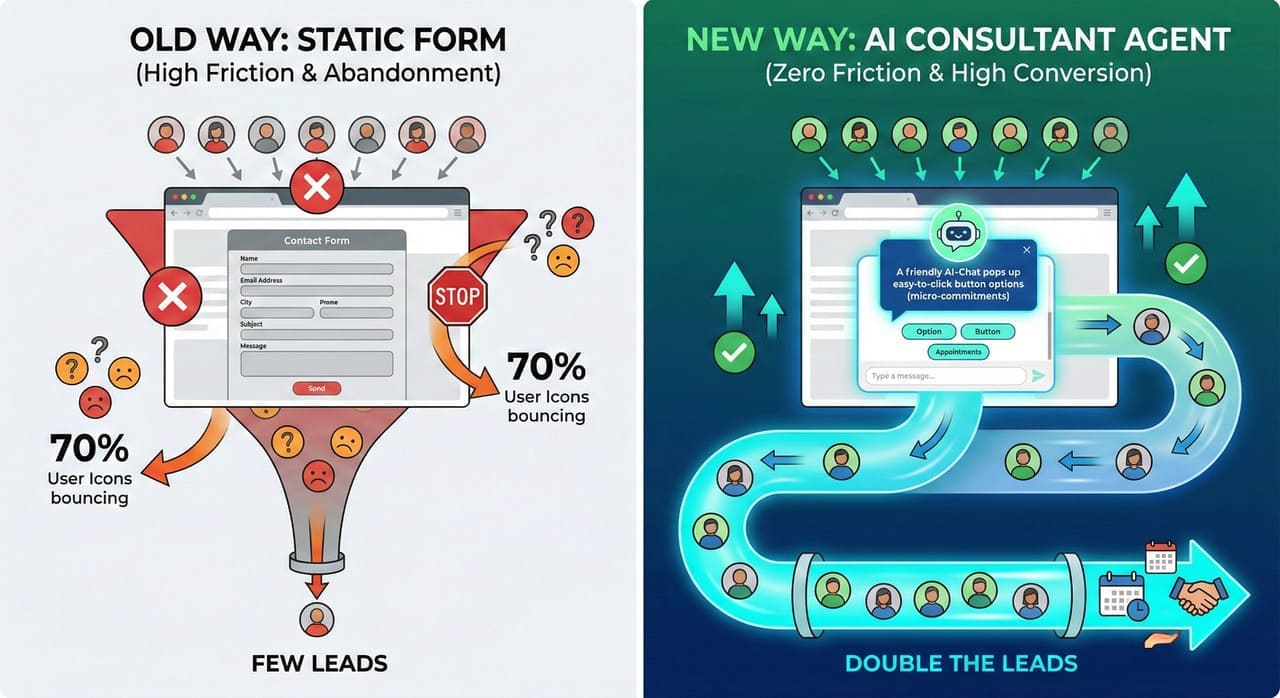
At that moment, their motivation plummets. Global statistics in 2026 show a clear and painful picture: 70% of customers abandon the site the moment they are required to fill out a static form. They don't abandon because they don't want to buy; they abandon because the process feels outdated, slow, and disconnected. They tell themselves "I'll do it later", and "later" never comes.
The Economic Cost of Delay (The Cost of Friction)
Let's talk money. Suppose you invest 10,000 NIS a month on advertising (Google/Facebook Ads). This budget brings you 1,000 visitors to the site. Out of these 1,000, suppose 100 clicked on "Contact Us".
- On a site with a regular form: Only 30 will fill out the form (70% abandonment). Out of those, you'll manage to catch only 15 on the phone.
- On a site with an AI Agent: About 60 will start a conversation (because it's easy and inviting). Out of those, the agent will qualify 40 as relevant and schedule a meeting with them.
The difference is double the number of leads, on exactly the same advertising budget. Your form is the bottleneck of your business.
The Psychology of Abandonment: Why Do We Hate Forms?
To understand the problem, you need to get inside the head of the modern digital consumer. We live in an era of Instant Gratification. We are used to getting answers now, ordering a taxi now, and watching a movie now. The contact form is the exact opposite of all these.
- The Uncertainty Anxiety: When I fill out a form, I send a message into a void. Will anyone read this? When will they get back to me? In an hour? Tomorrow? Or maybe on Sunday afternoon when I'm right in a meeting? This unknown creates a psychological friction that causes the customer to give up and look for a competitor who is available now and gives them attention.
- Unnecessary Cognitive Effort: It sounds funny, but filling out a name, phone number, and formulating a message ("Hello, I wanted to inquire about...") requires mental effort. The customer has to think about what to write, how to phrase it, and whether to detail the entire problem. Clicking a button in a chat or choosing a ready-made option is much easier. The human brain will always prefer "The Path of Least Resistance".
- Feeling Like a "Number" in the System: A form makes the customer feel like just another row in your Excel. They want to feel VIP, that someone is listening to them and understands their specific need. A form projects coldness and bureaucracy ("Submit a request and we will review it"), while a conversation projects caring and service ("How can we help you?").
The Mobile Gap
It's important to remember: over 60% of traffic to your site comes from mobile devices. Filling out a form on mobile is an ergonomic nightmare. Typing a long email address with your fingers, switching between fields, correcting typos - all this is frustrating. In contrast, a chat interface (like WhatsApp) is the most natural environment on a phone. Our fingers already "know" how to text. This is why mobile chat converts 300% better than a form.
Want to consult with us?
We can help you choose, build and deploy the perfect AI solution for your business. Leave your details and we'll get back to you.
The Revolution: From Forms to Conversations
The good news is that there is an alternative, and it is already changing the rules of the game for thousands of businesses in Israel and worldwide. The transition from dead forms to live conversations using smart assistants such as a lead generation chatbot.
With a Consultant Agent we don't ask the customer to "fill in details" passively. We initiate a relationship with them.
Imagine the difference in experience:
- The Old Way (2020 Website): A static page with a "Contact Us" title, name field, phone field, generic "Submit" button, and a dry thank you message.
- The New Way (AI-Native 2026): A chat bubble pops up in a friendly manner with a personalized message: "Hi! Welcome. I saw you were interested in business consulting. Is your business in the services or commerce sector?"
The Power of the Micro-Commitment
Notice the psychological difference: the customer doesn't have to "think" or type. They just need to click the "Services" button. Once the customer clicks an answer, they have already made a Micro-commitment. They are already engaged. They are already invested in the process. From here, the momentum does its thing, and the path to conversion is much shorter and easier. The AI takes them hand in hand until they leave their full details.
Why Does an AI-Based Chat Beat Any Form? (The Data Doesn't Lie)
1. Response Speed = Closing Rates
In the sales world, time is your biggest money. Our Consultant Agent doesn't sleep, doesn't go on a lunch break, and doesn't get sick. It answers within seconds, 24/7. The customer gets a response exactly when their need is at its peak ("strike while the iron is hot"), and not when they are already busy with something else. Studies show that a customer who received an answer within a minute is 7 times more likely to close a deal compared to a customer who waited an hour.
2. Lead Qualification
A regular form is "dumb". It puts everyone into your CRM in a jumble: serious customers with a budget, spammers, snooping competitors, and people looking for a job. Your salespeople waste hours filtering this garbage. Our agent, on the other hand, knows how to ask the right questions in real-time:
- "What is your budget for the project?"
- "When would you like to start?"
- "Do you already have an existing website?" It politely filters out the irrelevant ones ("It seems we are a less fit at the moment"), and schedules meetings in the calendar only with the "ripe" leads that are worth your precious time.
3. Hyper-Personalization Experience
The agent remembers the customer (if they return). It knows how to adjust the tone (formal for lawyers, casual for the industry), the language (Hebrew, English, Russian), and the marketing offers to whoever is standing in front of it. It's the difference between throwing a fishing rod into the sea and hoping for the best, and precise fishing with a laser harpoon.
Success Story: A Law Firm That Doubled Its Leads
A client of ours, a large law firm in Tel Aviv, suffered from "landing page abandonment". Customers came in from the campaign, saw a long and scary form ("describe the case"), and ran away. We replaced the form with a Consultant Agent that asked one simple question with buttons to choose from: "Hi, on what legal issue can we help you today? (Divorce / Real Estate / Torts)". The result? A 120% increase in the number of leads in the first month. The customers felt that someone was listening to them immediately, and this created critical initial trust. Someone suffering from a legal problem wants a listening ear, not a bureaucratic form.
Frequently Asked Questions (FAQ)
Q: Will my customers like talking to a robot? Isn't it alienating? A: The data shows the exact opposite. Customers prefer an immediate response from a smart bot over a long wait for a human response or a form that is never answered. When the bot is high quality, polite, and helpful, the service experience improves miraculously.
Q: Should I completely remove the forms from my website? A: We recommend leaving a contact form in one secondary location (like a "Contact Us" page or in the footer) for those who insist, but making the Agent the main and prominent channel. Most customers will choose the easy way.
Q: Does it work well on mobile? A: Absolutely yes. Our interface is 100% Mobile First and simulates a familiar WhatsApp experience, which significantly increases conversion rates among smartphone users.
Q: Does the system integrate with my CRM? A: Yes. Every conversation, every lead, and every detail collected by the agent automatically goes into your management system (HubSpot, Salesforce, Pipedrive, etc.) in real-time.
Q: How long does it take to set up such an agent for my website? A: The setup process at WhaleBiz is fast. Within a few days, we characterize, build, and integrate the agent on your site, and it starts working.
Stop letting leads escape just because of bureaucracy and exhausting forms. Let AI turn every visitor into a paying customer, with a smile and speed.
Want to see how it works on your site? Click here for a demo call.

Michael Romm
Michael is the founder and CEO of WhaleBiz, leading business and marketing strategy. An expert in data (SQL, Python) and developing automation and AI solutions for businesses.