
Meta's Official API Strategy for 2026: The Shift to Authorized Tools

Update note (5.8.2026): This article was written in December 2025, and its central predictions all materialised. We have updated it to reflect what actually happened since: the ban on general-purpose AI assistants taking effect on 15 January 2026, a revision of the business terms on 6 March 2026, Meta launching its own agent on 3 June 2026, and the move to token billing on 1 August 2026. We also corrected the pricing section: the original text described the 24-hour conversation model, retired on 1 July 2025, and the free tier of thousands of service conversations, which no longer exists.
August 2026: the grey methods are over, and this is no longer a forecast
When this article was written in December 2025, its central claim was that official integration was moving from "nice to be compliant" to "a precondition for business continuity". Eight months later that is not a forecast but a description of reality: every announced date took effect, Meta tightened the terms once more, and in parallel it entered the market itself as a competitor on the very layer that third-party vendors sell.
The strategic choice facing marketing managers and business owners is not "which third-party tool do we use", but how to use Meta's official, documented APIs to survive and grow, and what remains yours at the end of the process.
| Date | What happened | Strategic implication |
|---|---|---|
| 3.2.2025 | Platform Terms and Developer Policies update | Every violation becomes a deliberate breach of contract, with legal and not merely technical exposure |
| 1.7.2025 | End of the conversation model, shift to per-message pricing | Genuine budget transparency, but also the end of the free tier micro-businesses relied on |
| 15.10.2025 | Ban on general-purpose AI assistants takes effect for new accounts | Meta separates business automation, which it encourages, from general assistants on its infrastructure |
| 15.1.2026 | The ban takes effect for all remaining accounts | How you classify what you are building becomes a contractual question, not a matter of taste |
| 6.3.2026 | Revision of the WhatsApp business terms | A carve-out for EEA and Brazil numbers that does not cover Israel, and a ban on training models on conversation data |
| 3.6.2026 | Global launch of Meta Business Agent | Meta shifts from infrastructure operator to competitor on the agent layer |
| 1.7.2026 | Rate update and volume tiers | The current rate card, with volume discounts for Utility and authentication only, at volumes relevant to enterprises |
| 1.8.2026 | Token billing for Meta's agent | The AI layer gets its own meter, independent of the customer's country |
| 1.10.2026 | Service messages and in-window Utility templates become billable | The channel stops being "free when replying" and becomes metered end to end |
The conclusion from this table is not "Meta is raising prices". It is that Meta is making the channel predictable while simultaneously pricing every layer of it. A business built on the assumption that WhatsApp is a free channel discovers this on an invoice. A business built on official infrastructure with ownership of its data simply updates the budget.
Part 1: The requirement for full compliance, February 2025 to March 2026
The Platform Terms and Developer Policies update effective 3 February 2025 changed the rules. Meta no longer looks the other way. Every violation is treated as a deliberate breach of contract with immediate legal and technical consequences. Three layers of requirements, all still in force:
1.1. Transparency and user consent
- Privacy policy availability: developers and businesses must ensure their privacy policy is accessible to Meta's crawlers and sits at a URL open worldwide, with no geographic blocking. This lets Meta run automated, continuous compliance checks.
- Binding consent for profiling: the requirement for explicit valid user consent before creating or enriching user profiles applies to all developers, not only tech providers. The clause exists to eliminate data collection practices users never knew about.
1.2. Strict regulation and prohibited practices
- Authentic accounts only: every application or automation must be developed and managed under a real, verified user account. Account farms or fictitious profiles are grounds for immediate suspension of the Business Manager and every asset linked to it.
- Ban on metric manipulation: a blanket prohibition on buying, selling or exchanging likes, shares, followers and comments. Meta's detection systems identify these patterns quickly.
- Pages API rules: developers may not charge for the mere creation or management of a page, and must provide tools to prevent place duplication.
1.3. The two additions of 2026
This is the material update that was missing from the original text:
15 January 2026: the ban on general-purpose AI assistants. Meta prohibited AI providers whose product is the general-purpose assistant itself from operating on the WhatsApp Business Platform. Automation that serves a defined business process is not merely permitted but encouraged. That distinction is easy to miss and it determines whether the product you are building is legal. We broke down the exact boundary, what happens to a banned number and the list of questions to ask a vendor in a separate article: AI agents on WhatsApp, what is allowed and how to keep your number.
6 March 2026: revision of the business terms. Two clauses every decision maker should know. First, a carve-out permitting these technologies for users registered with a European Economic Area or Brazil country code, which does not cover an Israeli number. Second, a prohibition on using Business Solution Data, meaning your conversations with customers, to create, develop, train or improve AI systems, except for fine-tuning a model intended for your exclusive use. That second clause is a due diligence question for any vendor you are considering.
1.4. Scalability and API limits
The official APIs were built to scale, but they require proper management. Applications crossing 5 million monthly active users (MAU), more than 100 million API calls a day or 50 million impressions enter a stricter oversight regime.
At the WhatsApp layer there are two limits that matter even to a very small business, and both kill campaigns quietly: a quality rating that caps sending volume based on customer reactions, and a dynamic per-user frequency cap on marketing templates, derived from that user's read rate and returning error 131049 instead of delivery once crossed. Designing an architecture without accounting for these is a recipe for collapse at peak.
Part 2: WABA, financial transparency and functional superiority
After the 1 July 2025 updates, the official WABA is the only solution offering both stability and accurate cost forecasting for managing your business WhatsApp channel.
2.1. What actually happened to the economic model
This is the part the original text described incorrectly, and it is worth saying so plainly. Until 1 July 2025 pricing worked on conversations of 24 hours, with a distinction between business-initiated and user-initiated conversations, and a free tier of thousands of service conversations a month. That model was retired.
Pricing today, and as of August 2026 this is still the state of play, works as follows:
- Billing is per delivered message, not per conversation. There is no longer a "price per inbound conversation".
- The rate is derived from two parameters: the template category (marketing, Utility, authentication) and the recipient's country. For Israel the charge is denominated in US dollars, not euros.
- Incoming messages from customers are free, with no announced intention to change that.
- The free tier of thousands of service conversations does not exist. From 1 October 2026 both service messages in the 24-hour window and Utility templates inside the window become billable.
- Volume discount tiers are carried by the rate card in force since 1 July 2026, apply to Utility and authentication only, are counted separately for each country and category pair, and open at volumes relevant to enterprises rather than small businesses.
The numbers themselves, including Israeli rates, the shekel conversions and what October adds to the bill, are broken down in the financial article: Meta's WhatsApp pricing, what is billed from August and October. What matters here is only the strategic principle: the channel moved from partial transparency with a subsidy to full transparency without one. That is bad for anyone who built on the free part, and good for anyone who needs to plan a budget.
2.2. Why grey WhatsApp is equivalent to throwing money away
Beyond the risk, the WABA offers capabilities that simply do not exist in unofficial solutions:
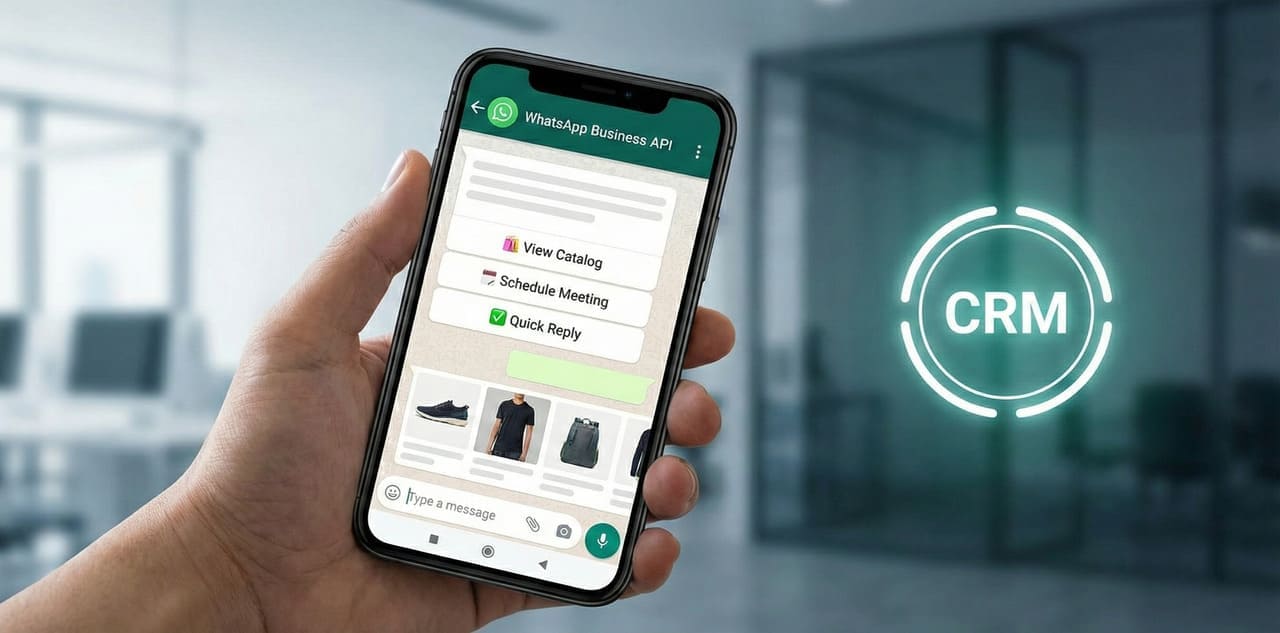
- Interactive buttons: call-to-action buttons and quick replies inside the message. Every removed friction point, such as having to type, reduces drop-off.
- Synced product catalog: a direct link between the WhatsApp catalog and your ERP and CRM systems. In the regular WhatsApp Business app the catalog is local, manual and out of date.
- WhatsApp Flows: complex forms inside the chat for booking appointments, selecting seats and running surveys, with no detour to an external site.
- Webhooks and a documented quality rating: you see what was delivered, what failed and under which error code. On a grey gateway you do not have that layer at all, which means you have no way to know why a campaign underperformed.
2.3. The real total cost of unofficial tools
Many are tempted by the cheap subscription price of bypass systems (Gray API), but the TCO is enormous:
- Immediate bans. Since 2025 Meta has significantly expanded automated detection of unofficial behaviour: non-human send timing, identical messages, a session that looks like WhatsApp Web. The ban is immediate, with no graduated warning and no effective appeal. For unsolicited outbound sending, ban rates reach tens of percent.
- Hidden costs. Proxy services, replacing burned numbers, losing data and history, campaigns going dark without warning, and development time spent on session fragility. All of these cost more than a few agorot per official message.
- What you lose is not the message. The business number is a marketing asset sitting on the signage, in the Google profile, in campaigns and in your customers' phones. The history that disappears with it is the part no external backup covers.
Want to consult with us?
We can help you choose, build and deploy the perfect AI solution for your business. Leave your details and we'll get back to you.
Part 3: Meta entered the market it governs
This is the major strategic development absent from the original text, and it redraws the map of considerations.
On 3 June 2026, at the Conversations conference in London, Meta launched Meta Business Agent globally: its own AI agent living inside WhatsApp, Instagram and Messenger, following pilots in India, Mexico and Brazil. From 1 August 2026 it bills for it on token consumption.
Two strategic conclusions, both more important than the price:
First, it closes the "Meta versus bots" debate. A platform that outlaws business automation does not launch a business agent of its own. What was banned in January 2026 is general-purpose assistants competing on the infrastructure, not business automation. Anyone who shelved an automation project because of press headlines shelved it on a false premise.
Second, the infrastructure provider is now also a competitor on the layer above. Meta operates the pipe and also sells an agent that runs inside it. That is not necessarily bad for a business, but it turns the ownership question from hygiene into leverage. Three questions that became critical:
- Who holds the WABA and the Business Manager. The right answer is you.
- Where the leads, conversations and history live, and whether you can export them in full.
- How many channels you hold outside Meta, so that your main channel is not a single point of failure.
You should also know what Meta's agent is and is not. Its self-serve versions run on the WhatsApp Business app rather than the API, answer inbound enquiries only, with no campaigns and no proactive follow-up, and with no connection to an external CRM, webhooks or API. The enterprise version, Meta Business Agent Platform, does run on the API and supports integrations, but it is in limited access, invite only. The full breakdown, including the financial comparison against a third-party agent in Israel, is in the pricing article.
Part 4: The Instagram platform, the keys to growth
The massive Instagram update launched around 10 December 2025 made the official Marketing API a mandatory tool for anyone measuring performance seriously, and that logic only strengthened through 2026 as Meta's business AI tools expanded across Instagram and Messenger.
4.1. Exclusive metrics for official API users
This data is simply not available through scraping tools or normal in-app viewing:
- Reels Skip Rate: the immediate drop-off rate, meaning how many people skipped the video within the first 3 seconds. This is the metric that tells you whether the hook works, and without it creative optimisation is guesswork.
- Advanced share counting: distinguishing shares of a specific post (media level) from shares of the profile (account level), which lets you understand virality in depth.
- Profile conversion tracking: syncing Ads Manager with profile visits that arrived from ads, for accurate ROI calculation.
4.2. Tools for creators and brands
- Competitive Insights: select competitors and compare head to head on follower growth rate, posting frequency and Reels performance.
- Automated report export: export all profile and performance data to a formatted PDF straight from the system, instead of hours of manual report production.
Part 5: The strategic verdict for August 2026
The rules tightened, the official tools became powerful, and the platform itself entered the market. The conclusion has not changed, it has only sharpened: moving to an official tech provider is not about "being compliant" but about competitive advantage. Five practical steps:
- An official WABA, with ownership that stays yours. The price difference is dwarfed by the capabilities, and by the peace of mind. See also our complete guide to a WhatsApp lead bot.
- Full compliance. Privacy policy accessibility and consent management per the February 2025 update, checked against the March 2026 revision, including the model training clause.
- Correct classification of what you are building. Automation of a business process, not a general assistant. Since January 2026 that is a contractual question.
- An updated budget for October 2026. Messages inside the 24-hour window stop being free. Anyone who does not budget for it in advance will find out on an invoice.
- Leverage the data. Use Instagram's API to work with real numbers like Skip Rate rather than gut feeling.
Our analogy: using unofficial solutions today is like insisting on drawing water from a pirated, contaminated well when you have a direct, clean and safe connection to the municipal mains. You may pay a monthly water bill, but the water always flows, it is clean, and nobody shuts off your tap mid-shower. And from October 2026 there is an addendum: the bill becomes more itemised, which is exactly why it can be planned.
WhaleBiz, your technology provider
At WhaleBiz we operate as an official Meta tech provider specialising in AI solutions for business. We do not look for loopholes, we build highways. Our team will help you make the move to official tooling, connect the WABA to your systems, and make sure leads and history sit in the WhaleBiz CRM included in every plan, with full export at any time.
Do not wait for the next ban. Get in touch and we will move your business onto the safe, growing track.
Frequently Asked Questions
What changed in Meta's enforcement policy starting February 2025?
The Platform Terms and Developer Policies update effective 3 February 2025 turned every violation into a deliberate breach of contract with immediate legal and technical consequences. Among the requirements: a privacy policy accessible to Meta's crawlers at a URL open worldwide, and explicit valid user consent before creating or enriching user profiles. These apply to all developers, not only tech providers. Two material updates have been added since: the ban on general-purpose AI assistants taking effect on 15 January 2026, and a revision of the business terms on 6 March 2026.
How does Meta price WhatsApp Business API messages in August 2026?
Per delivered message, not per conversation. The 24-hour conversation model was retired on 1 July 2025, along with the business-initiated versus user-initiated distinction and the free tier of thousands of service conversations. Today the rate is derived from the template category (marketing, Utility, authentication) and the recipient's country, and Israel is billed in US dollars. Incoming messages from customers are free. From 1 October 2026 both service messages and Utility templates inside the 24-hour window become billable. The full numbers are in the pricing article.
What capabilities does the official WABA offer that grey WhatsApp does not?
The official WABA offers interactive buttons and quick replies inside the message, which lift conversion rates. It also enables a product catalog synced directly to ERP/CRM systems, WhatsApp Flows for building complex forms inside the chat, plus webhooks and a documented quality rating. In unofficial solutions these capabilities simply do not exist, and the catalog stays local, manual and out of date.
What is Reels Skip Rate and why does it matter for Instagram marketing in 2026?
Reels Skip Rate is the immediate drop-off rate, meaning how many people skipped the video within the first 3 seconds, and it is the single most critical metric for judging your hook. It is available only through Instagram's official Marketing API and is not accessible through scraping tools or normal in-app viewing.
Does Meta launching its own agent change the strategy?
It reinforces it and adds a new consideration. On 3 June 2026 Meta launched Meta Business Agent globally, its own AI agent, and from 1 August 2026 it bills for it per token. The strategic implication: Meta is no longer only the infrastructure owner but also a competitor on the layer above it. That makes ownership of the WABA, the Business Manager and the CRM more important, not less.
Is AI automation allowed on WhatsApp after January 2026?
Yes, when it serves a defined business process. What was banned from 15 January 2026, and from 15 October 2025 for new accounts, are AI providers whose product is the general-purpose assistant itself. The 6 March 2026 revision adds a carve-out for numbers with a European Economic Area or Brazil country code, which does not cover an Israeli number, plus a prohibition on using conversation data to train AI systems. The full treatment is in the policy article.
What are the scalability limits of the official API?
Applications crossing 5 million monthly active users, more than 100 million API calls a day or 50 million impressions enter a stricter oversight regime. At the WhatsApp layer there are further limits that matter even to a small business: a quality rating that caps sending volume, and a dynamic per-user frequency cap on marketing templates that returns error 131049 once crossed.
What is the real total cost of an unofficial tool?
Beyond the cheap subscription there is a hidden cost layer: proxy services, replacing burned numbers, losing data and history, campaigns going dark without warning, and development time spent on session fragility. Since 2025 Meta has significantly expanded automated detection of unofficial behaviour, and for unsolicited outbound sending the ban rates reach tens of percent. The ban is immediate, with no graduated warning and no effective appeal.
Official sources
- WhatsApp Business Solution Terms (last modified 6.3.2026)
- Official WhatsApp Business Platform pricing documentation
- Per-user marketing template message limits (Meta for Developers)
- Meta Developer Policies
This article was published on 12.12.2025 and updated on 5.8.2026. Dates and models are accurate as of the update; the final rates for service messages and in-window Utility templates are due to be published by 1.9.2026. Verify against the official sources before making a business decision.

David Venzhyk
David specializes in building secure REST APIs and deploying scalable applications using Python, FastAPI, PostgreSQL, and AWS EC2. Combining his Computer Science background with experience in React and external API integrations, he engineers reliable, full-stack connected software infrastructure.