
AI Sales and Service Workforce: a Full Team in One Day

Imagine Staffing an Entire Department in One Day
An AI sales and service workforce is not another piece of software you buy and plug into the rest of your stack. It is a team you hire. Picture a Monday when you need to strengthen sales and service. The usual route takes months: post the vacancy, screen resumes, run interviews, negotiate the offer, wait out the notice period, pay for training, and hope the person does not quit within six months. Now picture a different Monday: by lunchtime you have a digital SDR on staff qualifying every inbound lead, a digital receptionist answering inquiries and booking appointments, and a digital support agent closing out repetitive customer questions. Not by the end of the quarter. By lunchtime.
That is the essence of the category WhaleBiz is building toward: you do not implement a tool, you staff a function. For an executive, this changes the very unit of planning. You used to think in licenses and modules. Now you think in positions and headcount - except these positions are digital. They have a role, a scope of responsibility, KPIs and a manager (you), but no salary in the usual sense, no ramp-up period and no resignation letter.
This article is about headcount. About what an org chart looks like when digital employees stand next to humans, which specific roles you can staff today, what each position costs per seat, and how to manage a blended team. If you want the bigger picture of how AI is reshaping employment across every business function, we covered that separately in our piece on the digital workforce and AI agents replacing employees. Here we deliberately narrow the focus to two functions - sales and service - and talk about the concrete roster of positions you can put into the field right now.
From the Staffing Plan to a Roster of Digital Employees
In classic HR, the staffing plan is a list of positions with responsibilities, requirements and cost. The digital workforce follows the same logic, which is convenient because you do not need to invent a new mental model. You still reason in terms of roles.
The difference is in how a position gets filled. A human vacancy is a hunt for a rare match of skills, motivation and availability on the labor market. A digital position is a configuration: you describe the role, give it access to your company knowledge, set behavioral boundaries and define the channels it works in. After that it goes live immediately and at full capacity. There is no learning curve where the new hire runs at 40% for the first two months.
A Position as a Set of Responsibilities, Not a Person
It helps to stop thinking of a digital employee as something technical. Think of it as a role with a clear mandate. The digital SDR is accountable for making sure no inbound lead goes unanswered and unqualified. The digital receptionist owns the calendar, appointment booking and first-touch intake. The digital support agent makes sure a customer gets an instant answer to a routine question, at any hour of the day. Each of these positions has a clear success metric, and you manage them the way you would manage people - through goals and feedback.
One Employee or a Team of Roles
An important distinction here. The digital workforce is about headcount - how many positions you have in the field and which ones. How those positions technically coordinate with each other, how context passes from the qualifier to the appointment scheduler and on to support - that is a question of architecture, and it gets its own conversation in our piece on the multi-agent orchestration platform. For an executive staffing a department, it is enough to know this: each role is self-contained, measurable and accountable, and under the hood they work in concert.
Human Employee vs Digital Employee: An Honest Comparison
When you plan a hire, you weigh several factors: what it will cost, how many hours a week the person actually works, how fast they get up to speed, how likely they are to leave, and whether you can scale quickly at peak. Below is a comparison across those axes. The goal is not to prove people are unnecessary. The goal is to show where each type of employee is strong.
| Parameter | Human employee | Digital employee (WhaleBiz) |
|---|---|---|
| Monthly cost | 8000-12000 plus taxes and a workstation | Fixed subscription per role |
| Working hours | 8-9 hours, 5 days, vacations | 24/7, no days off |
| Ramp to full productivity | 1-3 months of onboarding | Full capacity from day one |
| Turnover and resignations | High risk, knowledge walks out | Zero, knowledge stays |
| Scaling at peak | Slow hiring, overtime | Instant, up and down |
| Consistency of quality | Depends on mood and time of day | One standard in every conversation |
| Onboarding speed | Weeks of training and mentoring | Hours to configure the role |
The key takeaway from this table for a manager is not the cost row. The deeper economics of moving from a payroll cost model to a capitalized digital asset is a separate, bigger topic, which we unpack in our piece on the autonomous sales department. What matters more here are three rows that are not directly about money: ramp to productivity, turnover and consistency of quality. A digital employee does not take knowledge with it when it leaves, does not sag on a Friday evening, and does not handle the tenth customer of the day worse than the first. For sales and service, where speed and steady quality convert directly into revenue, those are the decisive parameters.
Want to consult with us?
We can help you choose, build and deploy the perfect AI solution for your business. Leave your details and we'll get back to you.
Which Roles You Can Staff Today
The AI workforce category is the direction WhaleBiz is heading toward as its north star: a team of fully autonomous digital positions running deals and service end to end. To keep this honest, let's separate what exists now from where we are going.
The Digital SDR
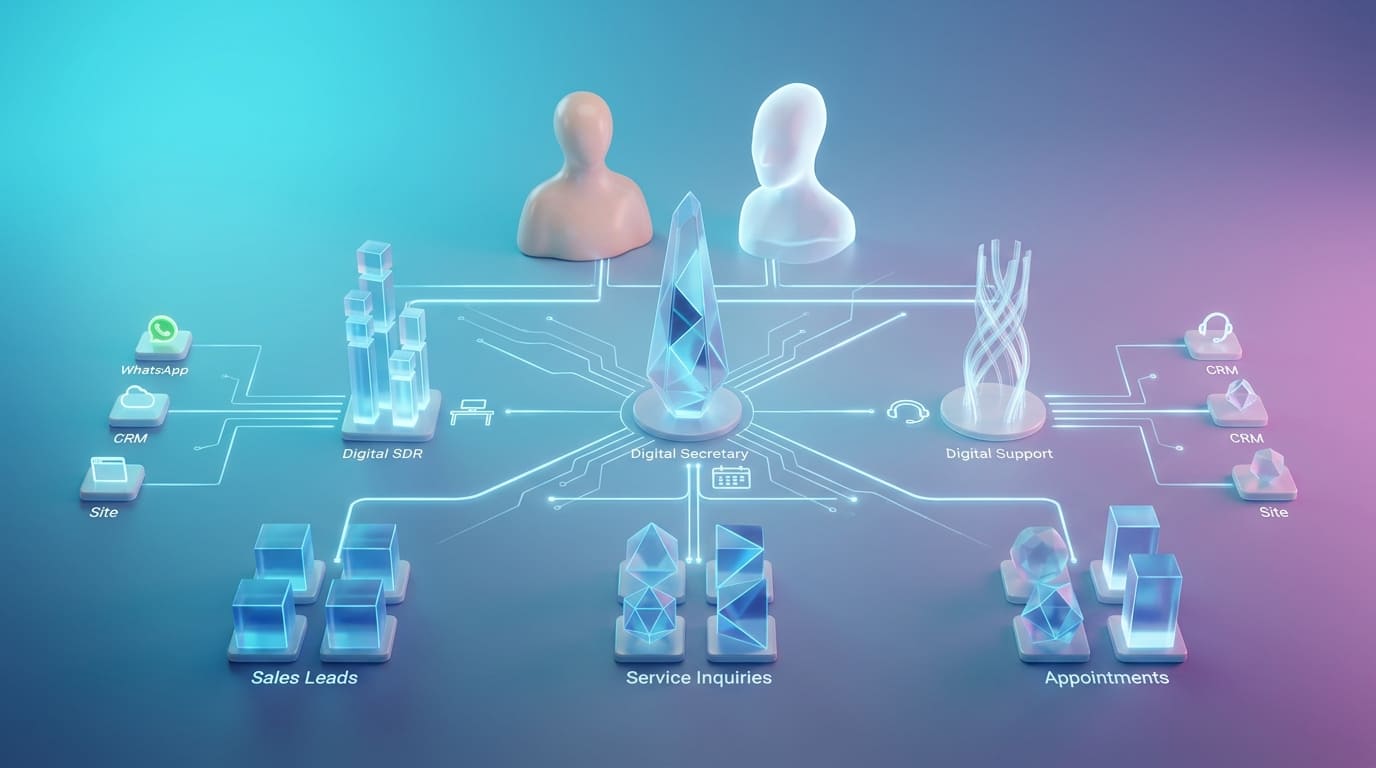
This is the first line of sales. The role exists to make sure every inbound lead from your website, WhatsApp, Instagram, Telegram or Facebook gets an instant response, is qualified against your criteria, and does not go cold while a human gets around to calling back. The digital SDR asks clarifying questions, filters out irrelevant inquiries, and hands hot leads forward with the context already gathered.
The Digital Receptionist and Front Desk
This role covers first contact and the calendar. It takes incoming inquiries, answers frequent questions, books appointments and keeps your schedule in order. That is especially valuable for clinics and service businesses, where booking an appointment is the key action. We go deeper into how this function works on the digital secretary solution page. The role works in Hebrew, Russian and English and supports voice.
The Digital Support Agent
This position takes the stream of repetitive questions off your human team's plate: order status, opening hours, terms, basic instructions. The agent draws on your company's knowledge and answers instantly at any hour, escalating to a human only what genuinely requires human judgment.
The Digital Appointment Scheduler
The role that turns interest into a booked meeting: it offers time slots, syncs with the calendar, sends reminders and rebooks when someone cancels. That cuts no-shows and frees your managers from coordination busywork.
What WhaleBiz Does Today, Plainly
Strip away the visionary frame and here is the present tense: right now WhaleBiz deploys AI agents on WhatsApp, your website, Instagram, Telegram and Facebook that capture and qualify leads, handle support, and book appointments 24/7, with a built-in WhaleBiz CRM, in Hebrew, Russian and English, voice included. Those are the digital positions you can put into the field this week. A fully autonomous team that runs a deal from first touch to close without a human in the loop is where we are headed - not something we pass off as a finished product today.
How to Manage a Blended Team of Humans and Digital Employees
The most common executive fear is that a digital workforce will turn management into chaos or strip the service of its human face. In practice the opposite happens, provided you set up the right division of labor.
Digital Employees Take the Volume, Humans Take the Complexity
The logic is simple: anything repetitive, predictable, and required to happen instantly and around the clock goes to digital roles. Anything that demands empathy, negotiation, non-standard judgment or a large check stays with people - but people now receive those tasks pre-prepared, with the context gathered and without the routine noise. For the wider strategy, see our guide to replacing employees with digital workers. Your best salesperson stops burning the morning on qualifying cold inquiries and spends it on what brings in the most.
You Become a Manager, Not an Operator
In a blended team your role shifts from execution to managing the roster. You decide which positions you need, what behavioral boundaries to set, which KPIs to measure and where to draw the escalation line to a human. In effect, you become the architect of the workforce rather than one of its gears. Scaling changes too: in peak season you add digital seats in hours instead of launching months of hiring, and you wind capacity down just as easily in the quiet season without painful layoffs.
Company Knowledge Stops Walking Out the Door
When a strong employee leaves, the business loses part of its accumulated expertise. Digital roles run on a single company knowledge base that stays in the business forever and only gets richer. Turnover stops being a threat to service continuity, and onboarding a new digital employee is not weeks of mentoring but a configuration update.
Frequently Asked Questions
What is an AI sales and service workforce?
An AI sales and service workforce is a team of digital employees you staff like regular positions: a digital SDR, a digital receptionist, a digital support agent, a digital appointment scheduler. Unlike conventional software, you reason about them in terms of roles, areas of responsibility and KPIs - not modules and licenses. Each role works 24/7, hits full productivity immediately, and is accountable to you as the manager.
Which sales and service roles can be staffed with digital employees?
Today you can field a digital SDR that qualifies inbound leads, a digital receptionist for intake and appointment booking, a digital support agent for routine questions, and a digital appointment scheduler. These roles work on WhatsApp, your website, Instagram, Telegram and Facebook, in Hebrew, Russian and English, with voice support. More complex deals and empathetic negotiations stay with people.
Does a digital workforce replace my human team or complement it?
It complements and amplifies it. Digital roles take on the repetitive volume, around-the-clock intake and instant response, while people focus on complex decisions, negotiations and large deals, receiving tasks with the context already prepared. It is a blended team where you become the manager of the roster. We look at the broader picture of AI's impact on employment in a separate piece on AI agents and the workforce.
How much does a digital employee cost compared to a human hire?
A human seat in sales or service runs roughly 8000-12000 a month plus taxes, a workstation and the cost of ramp-up in the first 1-3 months. A digital position is a fixed subscription per role with no hidden costs of recruiting, training and turnover. But the decisive difference is not just the number: a digital employee works 24/7, does not take knowledge with it when it leaves, and holds steady quality in every conversation.
How fast can you deploy an AI sales and service workforce?
Fundamentally faster than hiring people. Where human hiring takes weeks and months, configuring a digital role takes hours: you describe the responsibilities, connect the company knowledge base, set behavioral boundaries and channels. From there the position goes live immediately and at full productivity, with no ramp-up period. You can also scale the workforce up or down in hours, matching seasonal load.

Michael Romm
Michael is the founder and CEO of WhaleBiz, leading business and marketing strategy. An expert in data (SQL, Python) and developing automation and AI solutions for businesses.