
Multi-Agent Orchestration Platform: Why One Bot Degrades

Incident Review: Where "One Smart Bot" Breaks Down
A Multi-Agent Sales and Service Orchestration Platform is an architectural approach that replaces the single universal chatbot with a coordinated team of narrowly specialized AI agents, conducted by a dedicated orchestrator agent. For WhaleBiz this is an engineering north star - the direction we are building our technology toward, not a turnkey product that has already shipped. And the most honest place to start is an incident review - the kind of incident that repeats itself in every company that has put one bot in charge of everything.
Picture a WhatsApp thread at a private clinic. The message arrives at night. In a single thread the customer asks the price of an implant, immediately asks whether installment plans are available, requests a Thursday appointment, and mentions in passing that a previous filling fell out. For a human team this is four distinct competencies - a salesperson, a financing consultant, a booking administrator, and customer service. A monolithic bot tries to hold all of it in one "head" and one prompt. First it answers confidently about the price. Then, switching to booking, it drops the thread about installments. By the time it gets back to the complaint, it treats it as a brand-new conversation and asks the customer to "describe the problem in more detail" - the problem they already described. The conversion did not leak because the model is "dumb." It leaked because we asked one performer to be excellent at everything at once, and that never works - not for people and not for LLMs.
This is degradation under role load. The wider a single agent's zone of responsibility, the blurrier each individual competency becomes: the system prompt grows longer and more contradictory, the chance of hallucination spikes at the seams between topics, and the boundaries of authority get harder to police. The answer to this problem is not "a smarter model" - it is a different architecture: a team of specialized agents plus an orchestration layer that manages them. And the operative words in the category name are "and service": a real platform carries both axes, sales and service, on one infrastructure, without forcing the business to choose.
A plain-spoken note on where WhaleBiz stands today: our AI agents already run on WhatsApp, the website, Instagram, Telegram, and Facebook - capturing and qualifying leads, answering support requests, and booking appointments 24/7, with a built-in CRM, in Hebrew, Russian, and English, voice included. Full multi-agent orchestration with an autonomous conductor and end-to-end handoffs between specialized agents is where the product is heading, not a finished feature. We hold that line honestly throughout this article.
Why the Monolith Loses by the Very Nature of LLMs
There is a technical root cause behind the single bot's degradation, and it deserves to be named directly. An LLM operates within a context window and a single role defined by its system prompt. When you pile instructions onto that prompt - "be a salesperson, but also a support engineer, and a booking administrator, and stay within legal bounds, and never promise discounts, and keep the calendar in mind" - you create three problems at once.
First, instruction conflict: the selling role pulls toward "close the deal at any cost," the service role pulls toward "calm the customer down and solve the problem," and at the seam the agent chooses at random. Second, context dilution: the more roles and rules packed into one window, the less attention is left for the facts of the specific customer. Third, no boundaries of responsibility: it is impossible to tell "which part of the bot" failed, because there is only one part for everything.
A team of agents solves this through separation. Each agent is a narrow prompt, its own toolset, its own guardrails, and a single success metric. A narrow role is almost always executed better than a broad one - exactly the way, in any engineering system, the monolith eventually gives way to services with clear contracts between them.
Who Is on the Team and Who Conducts It
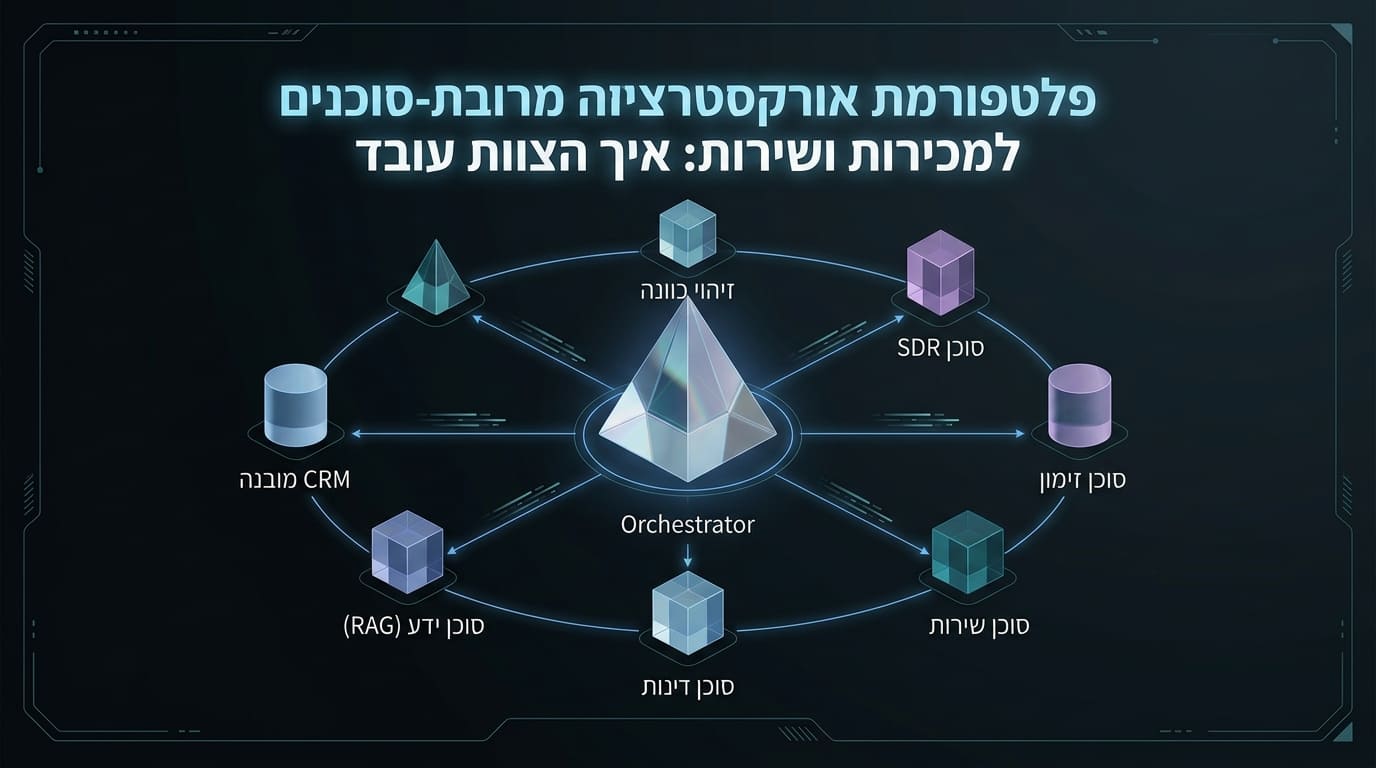
A mature orchestration platform is not one giant prompt - it is a score of roles with a conductor. In the WhaleBiz vision, the team looks like this.
The Orchestrator Agent (the Conductor)
This is the coordinator, and it barely talks to the customer about the substance of the deal. Its job is to recognize the intent behind every message, decide whose competency it falls into right now, hand the turn to the right specialist, hold the overall state of the conversation, and decide when it is time to bring in a human. The conductor does not play the instruments - it makes sure the orchestra sounds like a single whole and that the transition from one part to the next is invisible.
The Specialists Under the Conductor
- Intent router. The first filter: is this sales or service, a new lead or an existing customer, routine or a sensitive case? The entire score downstream depends on its accuracy.
- SDR / qualifier. The first-touch sales agent: it qualifies the lead against the business's criteria, screens out off-target inquiries, enriches the profile, and passes the hot contact onward.
- Scheduler (booking agent). A narrow but critical part: it checks availability, proposes slots, books the meeting on the calendar, and records it in the CRM, ruling out double bookings.
- Service agent. Works with existing customers: statuses, common problems, escalations. Its metric is not conversion but resolution rate, and it is the one that covers the "service" axis the monolith usually fails.
- Knowledge agent. It never talks to the customer directly - it serves the rest of the team, pulling verified facts from the business's knowledge base via RAG so that both sales and support lean on the company's documents rather than the model's "memory."
One principle holds: each agent does one thing and does it well, and the conductor binds them into an organism. That is what separates a "platform" from a "bot." A system of this depth cannot be bought as a boxed product - it is engineered for a specific business, and that is exactly the logic WhaleBiz builds into its direction of custom AI solutions: not a universal bot, but a purpose-built team of agents with clear roles and clean seams between them.
Handoffs, Guardrails, and Observability: What Reliability Rests On
The hardest part of a multi-agent system is not the agents themselves - it is the seams between them and the control over the team. Three mechanisms do the work here.
Handoffs and Shared State
A handoff is the transfer of the turn from one agent to another along with all the accumulated context: conversation history, the customer's language, deal status, profile. Back to that nighttime thread at the clinic: the qualifier has already learned the customer's budget and language, the scheduler takes the baton and immediately proposes a slot without asking again, and the service agent sees the complaint about the filling in the same history. To the customer it is one continuous conversation, even though three specialists have taken the baton behind the scenes. What holds it together is shared state: the profile, the cross-channel history, and the open tasks live not in one bot's memory but in a shared layer. This is where the built-in CRM stops being "external record-keeping" and becomes the team's working memory - and WhaleBiz is already taking the first step toward that today, automatically turning every conversation into a structured record with no manual field-filling.
Guardrails and Error Recovery
In a monolith, one link's failure brings down the entire conversation. In an orchestrated system, failures stay local. If the knowledge agent cannot find an answer, it says so honestly to the conductor instead of inventing a fact. If the sales agent tries to step outside its authority (promising a discount that does not exist), guardrails stop the action and escalate it to a human. Error recovery is not "the bot froze" - it is a managed degradation scenario: the system knows what to do when something goes wrong.
Observability as the Condition for Trust
You cannot manage what you cannot see. A single bot is a black box: you see the input and the output, but you do not understand why it answered the way it did. An orchestration platform gives you a trace: which agent took the turn, why the conductor handed the task to that one, which tools it used, where a guardrail fired. That turns the AI team from "magic you are afraid to trust" into an engineering asset you debug, measure against KPIs, and improve iteratively.
Want to consult with us?
We can help you choose, build and deploy the perfect AI solution for your business. Leave your details and we'll get back to you.
One Chatbot vs an Orchestration Platform
| Criterion | A single AI chatbot | Orchestration platform (WhaleBiz vision) |
|---|---|---|
| Scope of tasks | Every role in one prompt, mediocre everywhere | Narrow specialized agents under a conductor |
| Context transfer between steps | Lost at the seams, the customer repeats themselves | End-to-end handoffs with full state |
| Specialization and quality | Blurred competencies, conflicting instructions | Depth of role: each agent strong at its own job |
| Recovery and guardrails | One error breaks the whole conversation | Failures stay local, escalation to a human |
| Observability and audit | Black box: input and output only | A trace of every agent's decisions |
| Sales AND service | Overload, one of the axes sags | Both axes on one infrastructure |
The Conductor Stays Under a Human Architect's Control
A multi-agent platform does not mean "remove the people, the robots take it from here." In the WhaleBiz vision, the human moves out of the operator role - answering every message - and into the role of system architect. They design the agents' roles, write the guardrails, define the boundary beyond which the conductor must hand the turn to a human, and read the traces to improve the team's behavior. This human-in-the-loop is not a temporary crutch but a permanent structural element: the higher the stakes of a conversation (a large deal, a legally sensitive question, an unhappy customer), the earlier the system brings in a person. Low-risk routine - a standard question, an appointment booking - the team closes autonomously 24/7, and the architect moves that boundary as trust in the system grows.
Just as important: deep role specialization is the engineering layer beneath a broader vision. The orchestration architecture answers the "how" question for the autonomous sales department and feeds the throughput we explore in our piece on the autonomous sales and service engine. Without an orchestration layer, autonomy remains a slogan - it is the team of specialized agents that makes it achievable as engineering.
Conclusion: Not a Bigger Bot, an Orchestra
The future of AI in sales and service is not a race for "the smartest bot" - it is the engineering of agent teams. A single performer loaded with every role is doomed to degrade under the weight of competing competencies, and the more serious the business, the more visible the degradation. An orchestrated platform with specialization, end-to-end handoffs, shared state, guardrails, and observability turns scattered AI features into a managed industrial asset, equally strong in sales and in service.
That is exactly the direction WhaleBiz is building: from agents that already capture and qualify leads, run support, and book appointments 24/7 right inside the messenger, toward a multi-agent orchestration platform where a team of specialists plays as one orchestra under a conductor and a human architect. Not a bot. A platform.
Frequently asked questions
What is a Multi-Agent Sales and Service Orchestration Platform?
It is an architecture in which a coordinated team of narrowly specialized AI agents works in place of one universal chatbot (a Multi-Agent Sales and Service Orchestration Platform), managed by a dedicated orchestrator agent - the conductor. The platform carries both axes, sales and service, on one infrastructure, with context transfer between agents, guardrails, and observability. For WhaleBiz this is a direction of development and an engineering north star, not an already-delivered turnkey product of full autonomy.
How does an orchestrated multi-agent system differ from a single chatbot?
A single bot holds every role in one prompt and degrades under the load: instructions conflict, context dilutes, boundaries of responsibility disappear, and at the seams between tasks it drifts. An orchestrated platform splits the roles across specialists, each strong in its own domain, and provides end-to-end context transfer, failure containment, and decision tracing. The key practical difference is resilience on both axes at once - sales and service - with neither one sagging.
Which specialized agents make up the team, and who conducts them?
The team is coordinated by an orchestrator agent - the conductor: it recognizes intent, routes the turn to the right specialist, holds the shared state, and decides when to bring in a human. Beneath it work the intent router, the SDR/qualifier, the scheduler (booking agent), the service agent, and the knowledge agent, which supplies the others with verified facts from the knowledge base via RAG. Each does one thing well, and the conductor binds them into a single organism.
How do guardrails, handoffs, and observability deliver reliability?
Handoffs pass the turn along with the full context, so the conversation stays continuous for the customer even though several agents have rotated behind the scenes; shared state and a built-in CRM serve as the team's working memory. Guardrails contain a failure and escalate to a human instead of breaking the whole conversation or inventing facts. Observability provides a trace - which agent did what and why - turning the AI team into an engineering asset you can measure against KPIs and improve.
Does the human stay in a multi-agent platform?
Yes, and as a permanent element of the architecture, not a temporary crutch. The human shifts from operator to architect: designing the agents' roles, setting the guardrails, and defining the boundary beyond which the conductor must hand the turn to a human. The higher the stakes of a conversation, the earlier the system brings in a person, while the agent team closes low-risk routine autonomously 24/7.

Anthony Malts
Anthony is an AI Solutions Architect at WhaleBiz, overseeing the end-to-end architecture, system integration, and deployment of AI agents and enterprise solutions. He specializes in designing robust cloud infrastructure, scalable workflows, and tailored technology systems for businesses.