
Autonomous Sales and Service Hub (ASH): One Front Door
One customer, five queues and zero memory
Picture an ordinary day. A customer messages you on WhatsApp at 22:40 asking about price. No reply by morning, so they open Instagram and drop the same question into your Direct. Then they find your website and fill out the contact form. By lunchtime, patience gone, they simply call - and sit through hold music while "all of our agents are currently busy."
That is one person. One intent. One readiness to buy. But in most businesses it lands as four disconnected silos: WhatsApp has its own queue, Instagram belongs to a different employee, the website form falls into an inbox, and the call hits a phone center that knows nothing about the three previous touches. Every channel onboards the customer from scratch, like a stranger. The person retells their story for the fourth time and draws the obvious conclusion: nobody here remembers me, and nobody here values me.
Channel fragmentation is not an inconvenience. It is a structural leak that drains both revenue and reputation. And you do not fix it by hiring one more operator for each queue - you fix it by changing the model itself: instead of a pile of unconnected entry points, one Autonomous Sales and Service Hub. In Hebrew the idea has a natural name - מוקד מכירות אוטונומי and מוקד שירות אוטונומי: a single moked that pulls every channel into one point and one continuous customer context.
What is an Autonomous Sales and Service Hub (ASH / ASSH)
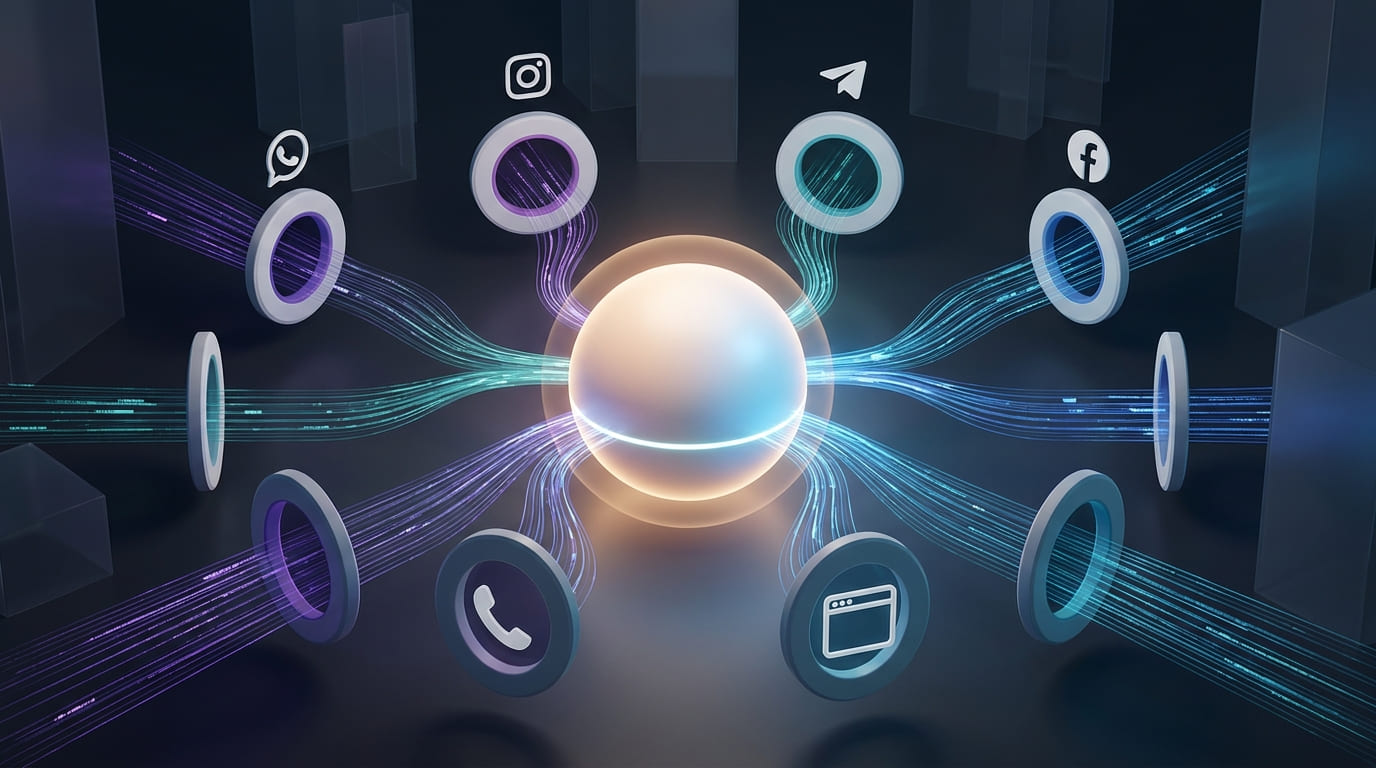
An Autonomous Sales and Service Hub (ASH, sometimes ASSH) is an always-on digital hub that takes inbound conversations from every channel - WhatsApp, Instagram, Telegram, Facebook, website forms and voice calls - and serves them as a single stream through one shared customer memory. I will use the acronym once, right here, and then simply say "the hub," so the text does not turn into alphabet soup.
The operative word is single. A traditional call center - the Israeli moked - is the place where phone calls converge. An autonomous hub is the place where the whole customer converges: their messenger thread, their social comment, their website inquiry and their voice on the line stop being separate "tickets" and become one continuous story. Sales and service walk through the same front door, with no shuffling the customer between departments and no second round of "your name, please?"
Let's set the register straight away. This is a category and a direction WhaleBiz is building toward, not a finished product of full autonomy. Here is where WhaleBiz stands right now: its AI agents already run on WhatsApp, the website, Instagram, Telegram and Facebook - capturing and qualifying leads, handling support and booking appointments 24/7, with a built-in WhaleBiz CRM, in Hebrew, Russian and English, voice included. That is the working core of the hub. A fully autonomous, closed loop that carries a deal all the way to the close without a human is the horizon we are moving toward, not a checkbox on a price list.
Why channel fragmentation costs more than it looks
When an owner prices out scattered channels, they usually see only operator salaries. The real cost hides in three places, and none of them shows up in any report.
Context loss between channels
Every time a customer moves from a messenger to a phone call, the context resets to zero. The person on the phone cannot see that an hour ago this customer was already quoted a price on WhatsApp - so they quote a different one. The customer catches the mismatch, and trust drops. In the fragmented model, the right hand literally does not know what the left is doing, because they are different hands, on different screens, working different databases.
Hold time as a tax on impatience
The queue and the hold music are a fine the business issues to a customer for wanting to buy. By many estimates, a large share of callers hang up before anyone answers, and in messengers patience runs even shorter: silence beyond a few minutes reads as "you don't matter to us." Every second on hold is one more chance the person walks to a competitor who answered instantly.
The artificial wall between sales and service
In the classic structure, the sales team and the support desk are two separate hubs staffed by different people. But the customer does not split their life into "buying mode" and "support mode." They just want their question solved. When a service inquiry is an upsell opportunity in disguise, and the support agent has neither the mandate nor the data to spot it - the sale simply never happens. A unified hub erases that wall: one conversation can start as a delivery question and end as a repeat purchase.
The traditional call center vs the autonomous hub
To make the difference concrete, let's compare the familiar call center (the moked) with the autonomous sales and service hub along the axes the customer and the owner actually feel.
| Parameter | Traditional moked / call center | Autonomous hub (ASH / ASSH) |
|---|---|---|
| Channel coverage | Mostly phone, everything else scattered | WhatsApp, Instagram, Telegram, Facebook, website, voice - together |
| Availability | Business hours and operator shifts | Full 24/7, no breaks |
| Hold time | Queue, hold music, "all agents are busy" | Response in seconds, no queue |
| Sales and service together | Different departments, different people | One front door for both |
| Cost per contact | Grows with every new operator | Nearly flat as volume grows |
| Context continuity | Every channel starts from zero | One customer memory across all channels |
| Languages and voice | Depends on whoever is on shift | Hebrew, Russian, English, voice |
The row that matters most is the second to last. Context continuity across every channel is exactly what turns a pile of bots into a real hub. Without it you do not get a center - you get five separate answering machines, each with its own short memory.
Want to consult with us?
We can help you choose, build and deploy the perfect AI solution for your business. Leave your details and we'll get back to you.
How a single hub reassembles the customer
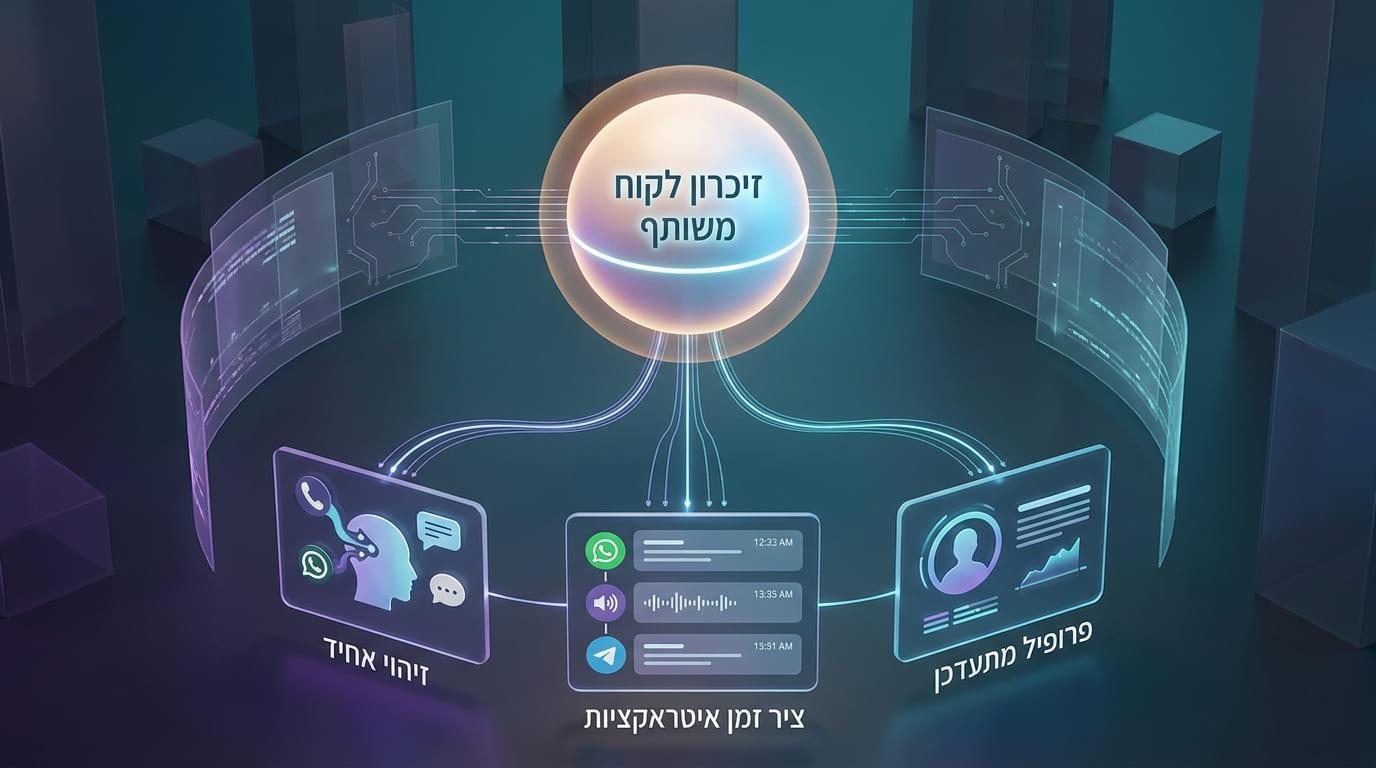
Unifying channels is not "plug every messenger into one dashboard." A dashboard is an operator interface; what we need is shared memory. The principle is simple: the channel is only a door, not the customer's identity. The person who wrote on Instagram and the person who called later are one entity with one history.
The channel is a door, not an identity
In the autonomous hub, customer identity lives above the channels. WhatsApp, Direct, the website form and the phone call are different entrances into the same room. So when the customer comes back through any door, the hub already knows who they are, what they asked last time and where the conversation left off. Retelling the story is never required.
One door for the sale and for the service
Because sales and service flow through the same hub, the classic handoff - "let me transfer you to another department" - disappears. The inquiry is handled where it landed, and when needed it shifts register smoothly, from support to upsell and back, without dropping the thread. For a closer look at the service side of this approach, see our support solutions.
Voice and text in a single profile
The voice call stops being an island. The transcript settles into the same customer profile as the chat history, so the next contact - text or voice - picks up exactly where the last one ended. For the Israeli market this matters doubly: the same customer can open in Hebrew, continue in Russian and confirm a detail in English, and the hub holds the entire thread.
Where the hub ends and the rest of the system begins
To keep the concepts sharp, the boundaries need drawing. The Autonomous Sales and Service Hub owns omnichannel unification - making every entrance converge into one continuous context. But that is one facet of a larger picture, and the neighboring categories own their own ground.
If the hub is about how the customer enters and through how many doors, the Autonomous Sales Department is about strategy and about who owns the business's intelligence as an asset. The AI sales and service workforce is about the org chart: which digital roles are "hired" and how the team scales. And the autonomous sales and service engine is about throughput and the physics of response: how many inquiries the system can pass through without loss. The hub draws on all of them but answers for one thing: that the customer has one entrance and one memory, whatever channel they choose.
This distinction matters in practice. When the owner of a clinic or a service business says "I need a moked," they almost always mean exactly this - unified channels and round-the-clock availability - not a philosophy of assets or an agent architecture. The autonomous hub is the answer to precisely that request, framed the way the customer on the other side of the screen actually feels it.
What actually changes for the business
Moving from disconnected channels to a single hub changes three things you can see with the naked eye.
First, hold time disappears as a phenomenon. Not shortened - gone, because the response in any channel arrives within seconds at any hour. Second, the customer stops retelling their story: the context travels with them from channel to channel. Third, sales and service stop competing for the customer's attention - they become two modes of one conversation, and a service inquiry quietly turns into a repeat purchase whenever there is a reason for one.
For an Israeli SMB - especially private clinics and service businesses, where one missed lead costs more than a month of advertising - this is the shift from "we try to reply as fast as we can" to "we always answer and we remember everything." That is the promise of the Autonomous Sales and Service Hub, the destination WhaleBiz is building the road to, starting from what already works today.
Frequently asked questions
What is an Autonomous Sales and Service Hub (ASH / ASSH)?
The Autonomous Sales and Service Hub (ASH or ASSH) is an always-on digital hub that pulls every customer communication channel into one point and one continuous context. In Hebrew the idea is naturally described as מוקד אוטונומי - a single moked serving both sales and service. It is a visionary category and the direction WhaleBiz is building toward, not a shipped product of full autonomy.
How is the autonomous hub different from a traditional moked / call center?
A traditional call center is essentially a phone queue staffed in shifts, while the other channels live separately and know nothing about each other. The autonomous hub covers every channel at once - messengers, social networks, the website and voice - and keeps one customer memory across all of them, answering in seconds with no hold. The key difference is not speed but continuity: the customer stops starting from zero with every new contact.
Which channels does the hub bring together in one place?
A single hub unifies WhatsApp, Instagram, Telegram, Facebook, website forms and voice calls. They stop being separate queues and become different doors into the same room with shared context. So a customer who starts in one channel and continues in another loses neither the history nor the stage of the conversation.
Can one hub run both sales and service at the same time?
Yes - and that is one of the core ideas. The customer does not label their inquiry "sales" or "service"; they just want it solved, so one front door serves both modes. A service inquiry can smoothly turn into a repeat purchase, and a pre-purchase question into a full consultation, with no transfers between departments.
Does the hub replace live call center operators or help them?
The goal of the autonomous hub is to take the grind of first contact, waiting and repetition off people's plates, not to fire the team. The hub absorbs the instant 24/7 response, channel unification and context keeping, freeing operators for the complex, emotionally loaded conversations where a human is irreplaceable. Today WhaleBiz delivers exactly this supporting role; a fully autonomous loop with no human in it is a direction, not a ready replacement.

Michael Romm
Michael is the founder and CEO of WhaleBiz, leading business and marketing strategy. An expert in data (SQL, Python) and developing automation and AI solutions for businesses.