
AI Agent Characterization for Businesses | WhaleBiz Smart Solutions
AI Agent Characterization: The Strategy Behind the Business's Digital Brain
The success of implementing artificial intelligence in an organization is not measured by the technology itself, but by the accuracy of the conceptual and data infrastructure it relies on. Characterizing an AI agent is the most critical stage in the process, where a business vision is transformed into a computerized operational model capable of understanding language, solving problems, and generating conversions. WhaleBiz, specializing in Data Science and artificial intelligence, identified that the main gap in the market stems from using generic systems that do not undergo personal customization. A real solution requires diving deep into the company's data, understanding the customer journey, and building a smart digital "personality" that knows how to perform active actions in core systems.
What is AI Agent Characterization and Why is it Essential?
In essence, characterizing an AI agent is sketching the architecture of the smart agent. If you are new to the concept, start with our guide to what an AI agent is. Unlike outdated chatbots based on rigid decision trees ("if the customer said X, answer Y"), a modern agent requires defining an action space, authorized knowledge sources, and rules of ethics and style.
It's a multi-layered process that includes defining goals (sales, service, or process optimization), characterizing the target audience, selecting the most suitable language model (LLM), and determining the required integrations. Without professional AI agent characterization, the business risks a bot that "hallucinates" answers, damages the brand, or simply doesn't provide the expected business value.
The Need for a Data-Based Approach
At WhaleBiz, we approach characterization from a Data Science perspective. This means the agent is not just "talking," but is connected to organizational data. We examine what data exists in the business - from PDF files of procedures to databases of inventory and sales - and make them accessible to the agent in a way that allows it to give answers based only on factual information.
The Central Components in Characterizing a Smart Agent
To create a system that truly revolutionizes, several layers must be addressed in characterization:
Defining the Role and Authorities (The Persona)
Is the agent an assertive salesperson? Or perhaps a patient and containing service representative? Characterizing an AI agent includes determining the tone of voice, level of formality, and its boundaries. It's important to define what the agent is not allowed to do - for example, giving discounts beyond a certain threshold or advising on topics outside its expertise.
Mapping Knowledge Sources (Knowledge Base)
This is the heart of a modern artificial intelligence agent. At this stage, we map all the information the agent needs to "ingest":
- Product and service guides.
- Successful conversation scripts from the past.
- Dynamic frequently asked questions (FAQ).
- Shipping and return policies.
Planning Integrations (System Connectivity)
A virtual agent reaches the peak of its power when connected to the organization's systems. Proper characterization will define how the agent pulls information from CRM or updates order status on the e-commerce site. Without this connectivity, the agent remains a "conversation machine" and doesn't become an efficient work tool.
The Difference Between Generic Solutions and Personalized Characterization
Many businesses are tempted to use cheap "off-the-shelf" solutions, but quickly discover they suffer from severe limitations.
| Parameter | Business Chat Bot (Generic) | Characterized AI Agent (WhaleBiz) ✓ |
|---|---|---|
| Language Understanding | Keywords only | Understanding context, slang, and user intent |
| Knowledge Source | Limited to what was manually typed | Access to all organizational data (RAG) |
| Personality | Robotic and cold | Adapted to the brand's DNA |
| Accuracy | Tendency to 'hallucinate' and errors | Data-based verification mechanisms |
| Performing Actions | Mainly displaying links | Performing transactions and changing data |
Stages in the AI Agent Characterization Process at WhaleBiz
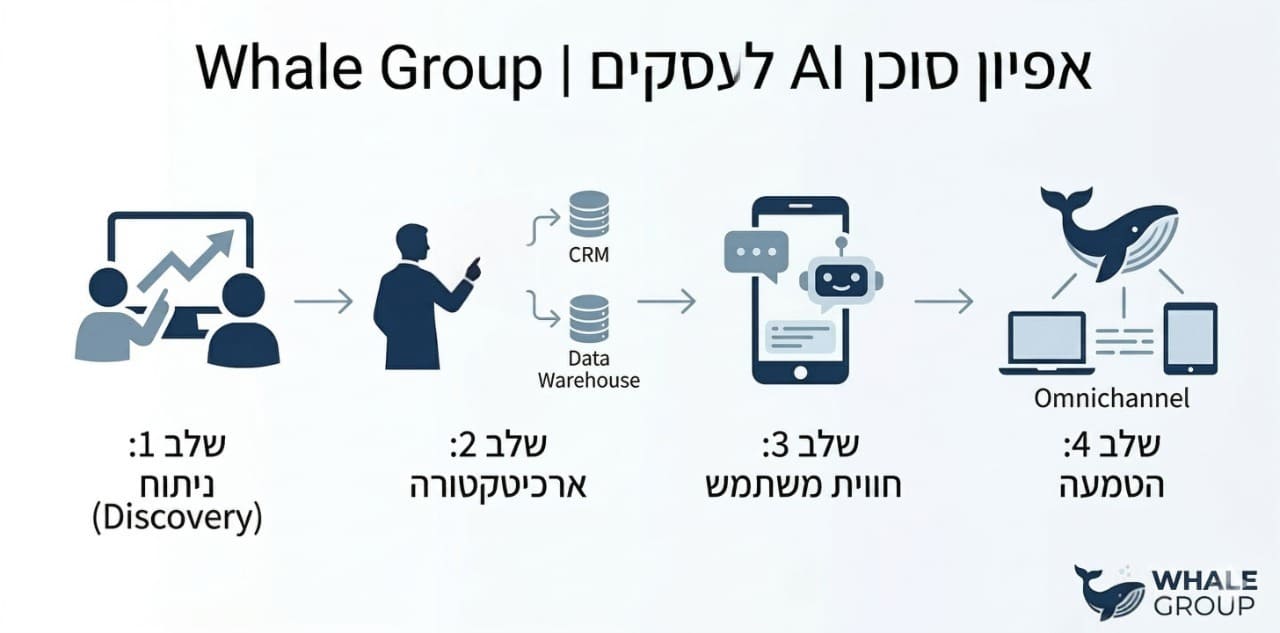
At WhaleBiz, we believe in an orderly and scientific process to ensure results.
Stage 1: Analyzing the Current Situation (Discovery)
Before starting to build, we examine how the business works today. Where are the bottlenecks? Which inquiries repeat themselves and exhaust human representatives? We use Data Science tools to identify patterns in existing conversations and website traffic.
Stage 2: Building the Information Architecture
At this stage, we decide on the technology. Is it right to use a closed or open model? How will we index the information so the agent retrieves an answer in less than a second? Here our expertise in building complex models comes into play.
Stage 3: Characterizing User Experience (Conversational Design)
A conversation with an AI agent should be flowing. We plan the main "paths" in the conversation, but leave the agent enough flexibility to respond to unexpected changes from the customer. The goal is that even if the customer asks a question in the middle of a purchase process, the agent knows how to answer and return to the sale smoothly.
Stage 4: Implementation in Distribution Channels
Is it a bot on the website? Or perhaps a WhatsApp chat bot that allows customers to close deals from their mobile? The characterization includes adapting the interface to each channel and channel, while maintaining information continuity (Omnichannel).
A thought to consider: An AI agent is the only employee in the business who never sleeps, never gets sick, and knows all organizational information by heart at any given moment. Is it characterized correctly to represent you?
Want to consult with us?
We can help you choose, build and deploy the perfect AI solution for your business. Leave your details and we'll get back to you.
Artificial Intelligence for Businesses: Revolution in Service and Sales
The world of Business Intelligence is undergoing transformation. Today, business automation solutions are not just a way to save money, but a way to create new value.
Improving ROI Through Precise Characterization
When an artificial intelligence agent is characterized correctly, it becomes a conversion machine. It knows how to identify when a customer is hesitating and give them the final "push" with the exact information they were missing. This is not just customer service, it's a growth strategy that directly affects the bottom line.
Monitoring and Real-Time Optimization
The work doesn't end with launch. As a data company, we monitor every conversation (anonymously and securely) to see where the agent succeeded and where it stumbled. We perform continuous "fine-tuning" so the agent becomes smarter and smarter with each passing day.
Q&A on AI Agent Characterization
Can an AI agent understand Hebrew at a high level?
Absolutely. WhaleBiz's expertise is exactly here - adapting advanced language models to the Hebrew language, with all its complexities, including understanding slang, cultural context, and syntactic nuances.
How long does a full characterization process take?
The initial characterization process can take between several days to two weeks, depending on the complexity of the data and required integrations. The goal is not to run too fast, but to build strong foundations that prevent future malfunctions.
Can the agent 'make things up'?
One of the challenges in artificial intelligence is 'hallucinations'. In professional characterization, we implement technology called RAG that limits the agent only to the information we provided it, so it doesn't answer questions outside its area of authority and doesn't invent facts.
What's the difference between an AI agent and a regular virtual agent?
An old-generation virtual agent operates according to a pre-set script. A modern virtual agent understands the meaning of the user's words and generates a dynamic, personalized response in real time, while learning from the interaction.
Technical Aspects: Behind the Scenes of Characterization
As Data Science people, we emphasize the technical architecture that ensures high performance.
Memory and Context Management (Context Window)
One of the impressive things in a well-characterized agent is its ability to remember what was said at the beginning of the conversation. We define how the agent manages its memory, so that if a customer says "the order we talked about earlier," the agent knows exactly what they mean without the customer having to repeat themselves.
Advanced Natural Language Processing (NLP)
We integrate tools that allow the agent to identify emotions (Sentiment Analysis). If the agent identifies that the customer is angry or frustrated, the characterization defines it to switch to a more conciliatory tone of voice or immediately transfer the conversation to a human representative.
Data Security and Privacy in the Characterization Process
In an era where data is the most valuable asset, we don't compromise on security. Characterizing an AI agent at WhaleBiz includes defining firewalls for sensitive information. We ensure the agent doesn't expose customers' personal information (PII) and that conversations are encrypted end-to-end. Your organizational information remains yours, and we use it only to make your agent the best in its field.
Compliance with International Standards
The agents we build are designed to meet the strictest privacy standards, ensuring that even companies in finance and healthcare can use the technology without fear.
Summary: The Future Belongs to Well-Characterized Businesses
The gap between a company that survives and one that thrives in the artificial intelligence era boils down to the ability to implement smart tools that really work. Characterizing an AI agent is not "another technology project," but building the beating heart of customer connection.
WhaleBiz brings to the table a rare combination of deep business understanding along with top-tier development and data science capabilities. We don't just build bots; we create excellent digital employees that change the face of the business. Our approach ensures that every interaction is accurate, every piece of data is utilized for the organization's benefit, and every customer feels they received a personal and high-level response.
Now that you've understood the importance of professional infrastructure, it's time to turn the vision into reality. We're here to take your data and turn it into the most powerful AI agent in your market. Our team is ready to start the precise characterization for you, so you can lead your industry with confidence and innovation.
Let's start characterizing your AI agent and lead the business into the new era.

Michael Romm
Michael is the founder and CEO of WhaleBiz, leading business and marketing strategy. An expert in data (SQL, Python) and developing automation and AI solutions for businesses.