
AI Agent for Car Dealerships: From the Yad2 Enquiry to the Test Drive
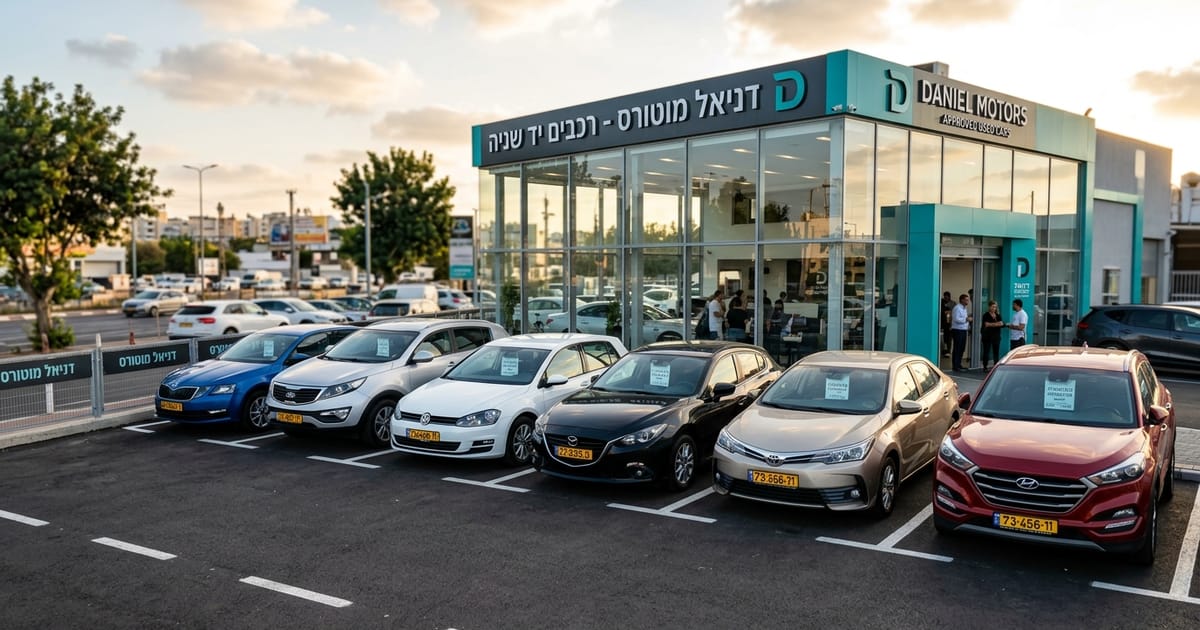
Two car lots in the same area, similar stock of about forty cars, near-identical ad budgets on Yad2 and Meta. One closes eleven cars a month, the other seventeen. Substitute your own numbers, but the gap almost never sits in the stock or the pricing, because both are too similar to explain a difference of six cars. It sits in the twenty minutes after a message about one specific car arrives, and in three questions about those minutes: who answered, what they asked back, and what was kept from the enquiry after that particular car was sold to someone else.
The enquiry is about one car, not about a service
This is the difference that breaks analysis imported from other industries. At a hair salon or a garage the customer contacts the business, so an enquiry answered late is still worth something. At a car dealership the customer contacts one item of stock they saw in an ad, and ten other people are contacting the same item in parallel. When the car sells, nine of the remaining enquiries evaporate even though thirty-nine other cars are standing in the lot, some of them a better fit.
Two practical conclusions follow. First, response time here is not politeness but position in a queue: whoever answers first books the appointment, and everyone else negotiates over a car that already has an interested buyer. We took that mechanism apart in the article on the first response window, and in car sales it is especially sharp because the ad itself invites an instant comparison between three sellers. Second, an enquiry still has value after the car is sold, but only if someone recorded what the customer was looking for: budget, body type, year, mileage and purpose. Without that, the next car to arrive in the lot has no idea who it suits.
The timing is awkward too. Enquiries on car ads are sent in the evening and at the weekend, while the buyer sits at home comparing dozens of listings, and salespeople are with customers in the lot exactly during the hours when answering is possible. That is a structural problem, not a discipline problem.
What is actually asked on first contact
The first-contact qualification is nearly always the same, which makes it a natural candidate for leaving the salesperson's personal phone:
- Which car this is about. A link to the ad or a plate number, so the conversation is not about "that white one".
- Intended use. First car, second family car, daily work travel, towing.
- Budget and payment structure. Cash available, financing, leasing, or paying in full.
- Trade-in. Whether a car has to be sold for the deal to happen at all.
- Timeline. Someone who needs a car within a week and someone starting to think about it next month are two different enquiries.
- Annual mileage. Determines whether the model they asked about fits at all.
- Preferences not in the ad. Automatic gearbox, number of seats, boot space, safety systems.
- Distance from the lot. Someone driving an hour will not come without being told the car is still here.
- What they have already seen. A customer who viewed three similar cars this week is at a different stage.
- Language. Hebrew, Russian or English, following the language the message opened in.
An AI sales and lead-qualification agent collects that list in a conversation rather than a form: one question at a time, branching on the answer, on WhatsApp and in the website chat, at ten at night and on Saturday. The result is a customer card in the WhaleBiz CRM with a short summary, so the salesperson enters a conversation that already has direction. When every enquiry is collected in the same structure, something otherwise hard to see also surfaces: which model generates many enquiries and few deals, and which ad brings people who are not in budget.
Trade-in: the question that decides whether there is a deal
In a large share of deals there is no purchase without a sale. The customer cannot take a different car before the current one is off their hands, so the trade-in question is not a technical detail at the end of the conversation but the condition that decides whether a deal exists. Many dealerships postpone it to the meeting at the lot, and discover there that the gap between what the customer expects to get and market value kills the entire meeting.
The agent brings that qualification forward without quoting a number: make, model, year and trim, number of owners, mileage, whether the car was a lease or a rental, whether a lien or open loan is registered, known faults and accidents, and photos from four angles and of the dashboard. Customers send those photos on WhatsApp with no effort, and an agent reply to a photo counts as exactly one message, the same as a reply to text.
The line here is clear: a valuation is given by a person. A number said in a chat is taken as a commitment, and any reduction from it after the appraiser has seen the car sounds like a trick and burns the car you wanted to sell as well. What you gain is time: instead of a fifteen-minute fact-finding call, whoever values the car opens a card with all the data and photos and answers in two minutes.
The test drive is the conversion, not the conversation
The destination of every enquiry in this industry is a physical meeting with the car, so it is worth measuring the agent by the number of test drives it booked rather than the number of messages it answered. The booking itself needs a short check that gets forgotten on the phone: who is driving, whether they hold a valid licence and how long they have held it, whether anyone else involved in the decision is coming, and which car exactly is ready to drive at that hour.
The agent offers only hours genuinely free in the calendar, writes the appointment down with the plate number, sends a reminder the evening before and allows a reschedule in one message instead of a phone call nobody picks up. A dealership that works with holding deposits can also collect a small payment inside the chat to hold a car for a day, which turns a test drive from a declaration into a commitment. That is exactly the logic of an AI secretary for scheduling and front-desk replies: not to replace the salesperson, but to make sure they meet people instead of chasing confirmations.
And without dressing it up: the agent can only offer what exists in a calendar and a stock list as a system. A lot where availability lives in three people's heads will get organised enquiries, but booking stays manual until the list is in order.
Four ways to handle an enquiry to a car dealership
| Measure | Website form | Lead arriving by email | The salesperson's phone | AI agent ✓ |
|---|---|---|---|---|
| Evenings and weekends | Collects, does not answer | Read in the morning | Depends who is free | Full, at any hour |
| Time to first reply | Hours | Hours | Between customers | Seconds |
| Qualification before a meeting | 3 to 4 fields | None | Depends who replied | Same list every time |
| Trade-in details and photos | Not collected | Not collected | Said, not recorded | Collected and stored on the card |
| When the car is sold to someone else | Enquiry dies | Enquiry dies | Depends on memory | Alternatives from stock offered |
| Splitting enquiries between salespeople | Whoever saw it | Whoever saw it | An unwritten rotation | By rules you defined |
| Customer history | A single email | An email thread | In someone's head | One card in the CRM |
| What it actually costs | Enquiries that fell asleep | Leads you paid for | Selling hours | A fixed monthly subscription |
The row worth stopping on is the fifth: it is the difference between a business that pays for the same lead twice and one that converts it to another car in stock.
Want to consult with us?
We can help you choose, build and deploy the perfect AI solution for your business. Leave your details and we'll get back to you.
Financing and leasing: where the line runs
The financing question arrives in almost every enquiry, usually phrased as "what does it come to per month". It is the question most tempting to answer fast, and the most dangerous. Financing is a regulated area, a number said without a check becomes an expectation, and a wrong answer comes back to you as a complaint after the customer has already stopped looking elsewhere.
So the agent does not quote a rate, does not calculate a monthly payment, does not promise approval and does not estimate the chance of approval. It does collect what lets the finance person answer in a single call: how much cash is available, whether a trade-in enters the deal, the repayment range that is comfortable, whether financing runs through the dealership or the customer's own bank, and when the car is actually needed. The customer immediately learns what happens next and when someone will be in touch, and that is the difference between waiting and walking away.
Weeks of follow-up: the car is sold, the customer stays
A car decision cycle is measured in weeks, and the drop-off inside it is silent: the customer does not announce they have given up, they simply stop replying. Four follow-up sequences cover most cases, and all of them are state-driven rather than date-driven:
- An enquiry about a car that sold. Not an apology message but two alternatives from stock that match the budget and need on record.
- Someone who did not show up for a test drive. A concrete window, and if there is no answer, one question about whether the car is still relevant.
- Someone who drove it and did not close. A short check of what was missing, price, financing or the model itself, so you know what to fix on the next deal.
- After the purchase. Reminders for the annual test and servicing, a Google review request, and a nudge towards friends shopping at the same stage.
The last sequence is also the bridge to the service side: a dealership with a garage or a service arrangement continues the same relationship instead of starting over, and the logic of replies and scheduling on that side is taken apart in the article on an AI agent for auto garages. Two rules keep it from turning into spam: a stop point after which the customer moves to a cold list, and any reply from them stops the sequence and hands it to a person. The number of automations and follow-ups is unlimited and there are no trigger meters, so a long sequence does not make the plan more expensive.
The red line: what the agent does not promise
In an industry where every car has a history, the boundary is written in sentences, not intentions. The agent does not give a trade-in valuation and does not commit to a price at which the customer's car will be bought. It does not declare a car accident-free and does not interpret an inspection report or service history, but refers to the documents and to a check at a licensed inspection centre. It does not quote an interest rate and does not promise financing approval. It does not approve a discount that is not on the price list, does not commit to a delivery date and does not give a technical opinion on a fault.
What it does close on its own is most of the traffic: availability and asking price from the stock list you approved, qualification of need and budget, collecting trade-in details and photos, booking test drives, rescheduling, reminders and follow-up on whoever went quiet. An enquiry that crosses the boundary goes to a person with all the context, and the customer knows when someone will get back to them.
What it costs and which plan to start on
A car dealership starts on Standard: ₪490 per month plus a one-time ₪1,990 setup, excluding VAT. That is the first plan with WhatsApp through the official Meta API and calendar booking, and in an industry where the enquiry arrives on WhatsApp and its destination is a test drive, without both there is no product. Start, ₪190 per month plus ₪990 setup, does not fit here: no WhatsApp and no appointment booking. A dealership with two lots and more than two calendars, replies on Instagram and Facebook, or holding deposits collected in the chat needs Business, ₪990 per month plus ₪2,990 setup. The full comparison is on the pricing page.
Think about the quota by your busiest month, because advertising a new model produces a wave of enquiries within two days. One message is one agent reply, incoming customer messages are not counted, and a reply to a photo or a voice note counts as one message just like text. In an industry where every trade-in enquiry arrives with four photos, that changes the arithmetic. Standard includes 1,800 messages with ₪0.38 per message over quota, and Business 4,000 messages with ₪0.32 over quota.
Setup on Standard is up to 14 business days, counted from the moment we receive all the materials rather than from payment. The setup fee is paid in one payment before work starts, and the subscription begins on the day the agent goes live. The materials we need from you already exist, just not in one place: an updated stock list with asking prices, your test drive and holding deposit policy, the distribution rules between salespeople, and the approved answer to questions about vehicle history and financing. Anyone who does not have those in writing discovers during setup that this, not the technology, was the real problem.
Frequently asked questions
Can the agent give a trade-in valuation? No, and this is the most important boundary here. A number said on WhatsApp is taken as a commitment, and any reduction from it after the appraiser has seen the car burns the whole deal. The agent does collect model, year, owners, mileage, previous lease or rental use, liens, faults and photos, so the human valuation takes two minutes instead of fifteen.
How does the agent know whether a car is still available? Only if stock exists as one updated list the agent can be connected to. Then it answers on availability, year, mileage and asking price from it. If stock lives in the salespeople's heads, the agent will not invent availability: it collects the enquiry, says availability is being confirmed with the lot and hands off to a person.
What about financing and monthly payment questions? The agent does not quote a rate, calculate a payment or promise approval. It collects available cash, trade-in, a comfortable repayment range, who the financing runs through and when the car is needed, then routes a defined enquiry to the finance person. The customer immediately learns when someone will be in touch, which is the difference between waiting and walking away.
We have two lots and four salespeople. How are enquiries split? With written routing rules: by the lot where the car sits, by enquiry type, by language and by availability, and only then by rotation. Every enquiry gets one card in the WhaleBiz CRM with a defined owner, so no two salespeople call the same customer and no enquiry is left with nobody.
Which plan do we start on and how long is setup? Standard, ₪490 per month plus a one-time ₪1,990 setup, up to 14 business days. That is where WhatsApp through the official Meta API and calendar booking live. Start, ₪190 per month plus ₪990 setup, does not fit: no WhatsApp and no booking. Two lots, Instagram or holding deposits in the chat require Business, ₪990 per month plus ₪2,990 setup. Prices exclude VAT.

Eva
Eva is the Events and Community Manager at WhaleBiz, leading community engagement, webinars, and professional industry events. Combining a background in behavioral sciences with digital strategy and SMM, she creates high-impact experiences and drives brand presence across social platforms.