
A Customer's Voice Message on WhatsApp: What an AI Agent Does With It, and When a Person Is Needed
Contents
- Why customers record instead of typing
- What happens to a voice message in a business without an agent
- What an AI agent does with a voice message
- A recording and a photo in the same conversation
- Where a person is still needed
- A five-minute test: does your WhatsApp answering understand recordings
- How it connects to the rest of the sale
- Frequently Asked Questions
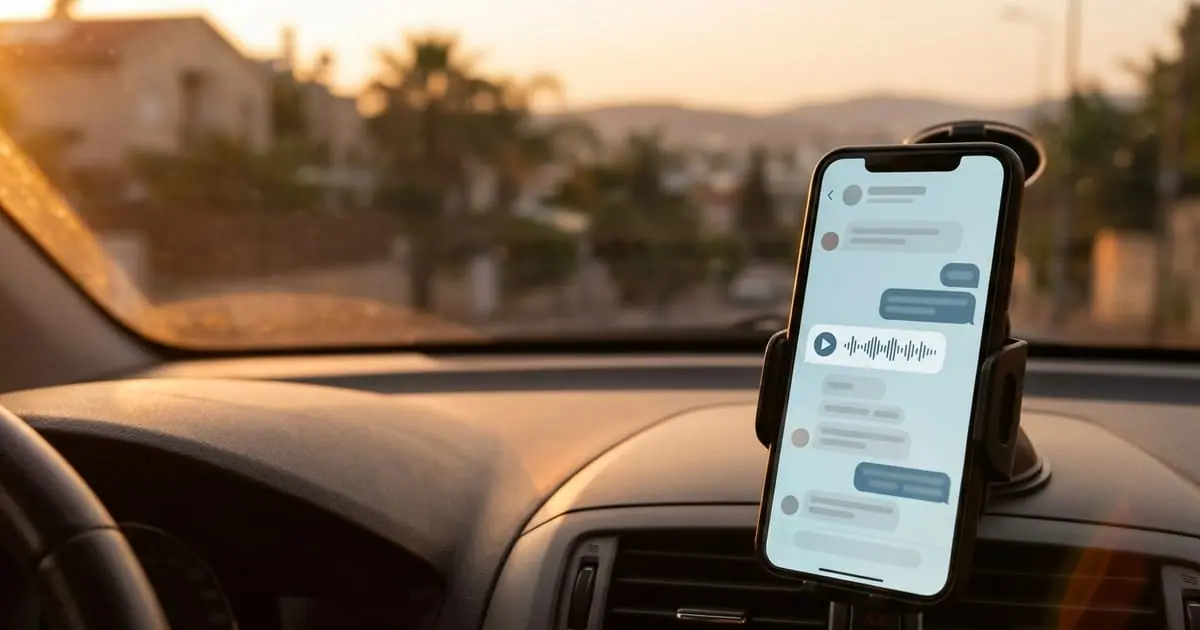
Most businesses set up their WhatsApp replies as if every customer types. In practice, plenty of enquiries arrive as a voice message: half a minute of "Hi, I wanted to ask..." from the car, from the supermarket queue or from the sofa after the kids fell asleep. A simple WhatsApp bot, the kind that answers frequently asked questions, gets stuck right here. It replies "Sorry, I didn't understand, could you type it?", and the customer, who already explained everything, has to start over. Some do. Some close the chat and send the same recording to the next business on the list. WhatsApp voice messages are not a glitch to work around; they are how many people talk to a business. An AI agent working for you has to understand them exactly as it understands text.
Why customers record instead of typing
It is worth knowing who sends a voice message and why, because it changes what they expect back.
- Their hands are busy. A driver on the way to work, a mother holding a baby, a plumber in the middle of a job. A long press on the microphone is the fastest thing there is.
- The story is long. "There's a noise from the front wheel, it started after the last service, and only when I slow down" is a sentence nobody wants to type on a phone. Recorded, it takes ten seconds.
- It is how they are comfortable. Some customers simply speak better than they write, and some speak a different language from the one the business writes in. A patient who speaks Russian or Arabic will not start writing in Hebrew just to book an appointment.
- Something is bothering them. Someone with a toothache at night, or whose order never arrived, talks. In writing they would send one line; out loud they tell you what really happened.
What they all share: they have already said everything they had to say. As far as they are concerned, the ball is now in the business's court.
What happens to a voice message in a business without an agent
In an ordinary business, a voice message waits for someone who can listen to it. That sounds simple, and it is not.
It waits for a quiet moment
A receptionist at a clinic will not play a patient's message next to three people waiting. A garage owner with oily hands will not listen in the middle of a job. So the message stays unanswered until the break, sometimes until the evening. And whoever sent it at eight in the evening may wait until morning.
It takes time nobody sees
Do a simple calculation for your own business: how many voice messages arrive a day, times how long each one is. Ten one-minute messages are ten minutes of listening alone, before anyone has replied, checked the calendar or looked up a price. Whoever heard a message in a rush between two customers sometimes has to play it again, because they missed the name or the time.
What was said is not saved anywhere
In the recording the customer said their name, what they need and when suits them. But a recording is not a customer card. If whoever listened did not copy the details, they stay inside an audio file on the business's phone. You cannot search them, you cannot filter by them, and whoever comes on shift later does not even know they are there.
What an AI agent does with a voice message
A WhaleBiz AI agent handles a voice message like any other message in the chat: it understands it, replies and carries the conversation on, at night and at the weekend too. Here is how it looks, step by step.
1. It understands what was said, in the language it was said in
The customer speaks Hebrew, Russian, Arabic, English or any other language, and the agent understands the content and continues the conversation in the customer's language. Nobody on the team needs to know Russian for the patient to get an answer.
2. It answers everything that was asked, even two questions in one recording
"I wanted to know how much whitening costs, and whether you have anything on Friday morning." Two questions, one recording. An agent that really understood the message answers both: the price according to what the business told it (a price list, a range, or "the price is set after an examination"), and Friday morning according to what is free in the calendar.
3. It books the appointment
When the customer said in the recording when suits them, the agent offers free slots and books the appointment. The calendar syncs both ways: an appointment booked in the chat shows up for the team, and a time the team blocked is never offered to the customer.
4. It saves the details in the CRM
The name, what the customer needs, when suits them and which channel they came from go into the lead card in the built-in CRM, together with the whole conversation. Whoever arrives in the morning sees what happened overnight without listening to a single recording.
5. It hands off to a person when needed
When the message is a complaint, when the customer asks to speak to someone, or when the question goes beyond what the business defined, the conversation goes to a person on the team, with the details already in order. The agent does most of the work, and a person steps in where they are really needed. That is how an AI agent that answers customers like a good secretary works.
What the business sets up in advance
The agent answers according to what the business gave it: the services, opening hours, address and parking, how to talk about price, what counts as urgent and who it goes to. It can also answer from the business's own documents, such as a pre-treatment instruction sheet or cancellation terms. The more precise the setup, the shorter and clearer the reply to a one-minute recording comes out, rather than a speech.
A recording and a photo in the same conversation
Many enquiries arrive as a bundle: a photo followed by a recording. A warning light on the dashboard and "what does this mean?". A photo of a tooth and "it's been hurting for two days". A photo of an old kitchen and "how long does it take to renovate one like this?".
The agent receives photos too and understands them together with the recording. It does not diagnose a car fault or give a medical opinion: it understands what it is about, offers the nearest slot for a check, and if the case is urgent by the business's rules, hands it straight to the team. It can also send back a photo, a video or a document when that helps the customer decide, such as photos of earlier work or preparation instructions before a treatment. We covered this in the article about an agent that sends and receives photos and videos.
Want to consult with us?
We can help you choose, build and deploy the perfect AI solution for your business. Leave your details and we'll get back to you.
Where a person is still needed
An agent that understands voice messages does not turn the business into a business without people, and it should not. There are cases where the right move is to hand off:
- An unclear recording. Wind, music in the background, a recording cut off in the middle. A properly configured agent does not guess what the customer probably said: it asks a short question to make sure, or asks them to type just the missing detail.
- An angry or anxious customer. A polite reply does not replace a person who gets back to them. Here it is right to hand off quickly, with a summary of what was said, so the customer does not have to tell the whole story again.
- A professional question. The agent answers what the business defined: hours, services, process, appointments. A diagnosis, an opinion or a promise of results stays with the professional.
- A phone call. A voice message in a chat is not a phone call. Answering calls is a different channel, and with us it is still in beta.
A five-minute test: does your WhatsApp answering understand recordings
Whoever or whatever answers your business WhatsApp today, you can test it from your personal phone:
- A recording from the car. Send half a minute with background noise and a real question. Does the reply address what you said, or ask you to type it again?
- Two questions in one recording. Ask about price and availability in the same message. Did you get an answer to both?
- Another language. Ask someone who speaks Russian, Arabic or Amharic to send a recording. What language did the reply come back in?
- A late hour. Send a recording at 23:00. How long did the first reply take, and what did it say?
- What is left afterwards. In the morning, check what was saved: a card with a name and a request, or just an audio file in the chat?
If two or more failed, voice messages in your business are waiting for a person. That is not the end of the world, but it is worth knowing how many of them arrive at hours when nobody is free. More checks worth running are in the article on what to test in an AI agent before it goes live.
How it connects to the rest of the sale
A voice message is only one point on the way from the first enquiry to a deal. What happens after it matters just as much: the appointment booked, the reminder before it, the message to a customer who has not decided yet. On the business's WhatsApp, a WhaleBiz AI agent is connected to the CRM and the calendar, so a recording sent at ten at night can end as an appointment in the calendar and a tidy lead before anyone on the team has opened their phone. It is one link in what we call the autonomous sales system. How the agent works in the channel itself is explained on the AI agent for your business WhatsApp page, and what each plan includes is on the plans and pricing page.
Frequently Asked Questions
Does an AI agent understand voice messages in any language?
Yes. The customer can speak Hebrew, Russian, Arabic, English or any other language, and the agent understands the recording and continues the conversation in the customer's language. Nobody on the team needs to know the language for the customer to get an answer.
What happens when the recording is unclear?
A properly configured agent does not guess. If a detail is missing, such as a name or a time, it asks a short question to make sure or asks the customer to type just that detail. If it is still unclear, the conversation goes to a person on the team.
Where is what the customer said in the recording saved?
The details from the conversation, such as the name, the request and when suits the customer, go into the lead card in the built-in CRM together with the whole conversation. That way whoever arrives in the morning sees what happened overnight without listening to recordings.
Does the agent also answer phone calls?
A voice message in a chat and a phone call are two different things. The agent understands WhatsApp voice messages today. Answering phone calls is a separate channel, and with us it is still in beta.
How much does an agent that understands voice messages cost?
An agent's reply to a voice message or a photo counts as one message, like any other reply. What each plan includes and what it costs is on the pricing page of the site.

Michael Romm
Michael is the founder and CEO of WhaleBiz, leading business and marketing strategy. An expert in data (SQL, Python) and developing automation and AI solutions for businesses.